• Skip to secondary menu
  • Skip to main content
  • Skip to primary sidebar

Eat Out Eat Well

  • Home
  • About
  • Eats and More® Store
  • Books
  • Contact

Holidays

Jelly Beans: Do You Eat Them By The Handful Or One-By-One?

March 27, 2013 By Penny Klatell, PhD, RN Leave a Comment

Jelly beans: do you think they should they should come with a warning label, “STOP NOW or you’ll keep eating until they’re gone?”

Seriously – it’s pretty darn hard not to love those little nuggets of sweetness that come in multitudes of colors and flavors and get stuck in your teeth!

The Birth Of The Jelly Bean

The gummy insides of the jelly bean might be traced back centuries ago to the treat, Turkish Delight. Their outsides bring to mind the colored hard candy coating, developed in the late 17th century, for the Jordan almond.

The modern jelly bean became popular during the American Civil War when Boston’s William Schraft encouraged sending candy to Union soldiers.

Jelly beans were the first bulk candy.  They became one of the staples of penny candy that was sold by weight in the early 1900s —

first mentioned in an ad in The Chicago Daily News on July 5, 1905 for bulk jelly beans at nine cents a pound.

Around 1930 they became popular as Easter candy because of their egg shape, which represents spring, fertility, and resurrection.

The Many Flavors And Colors Of Jellybeans

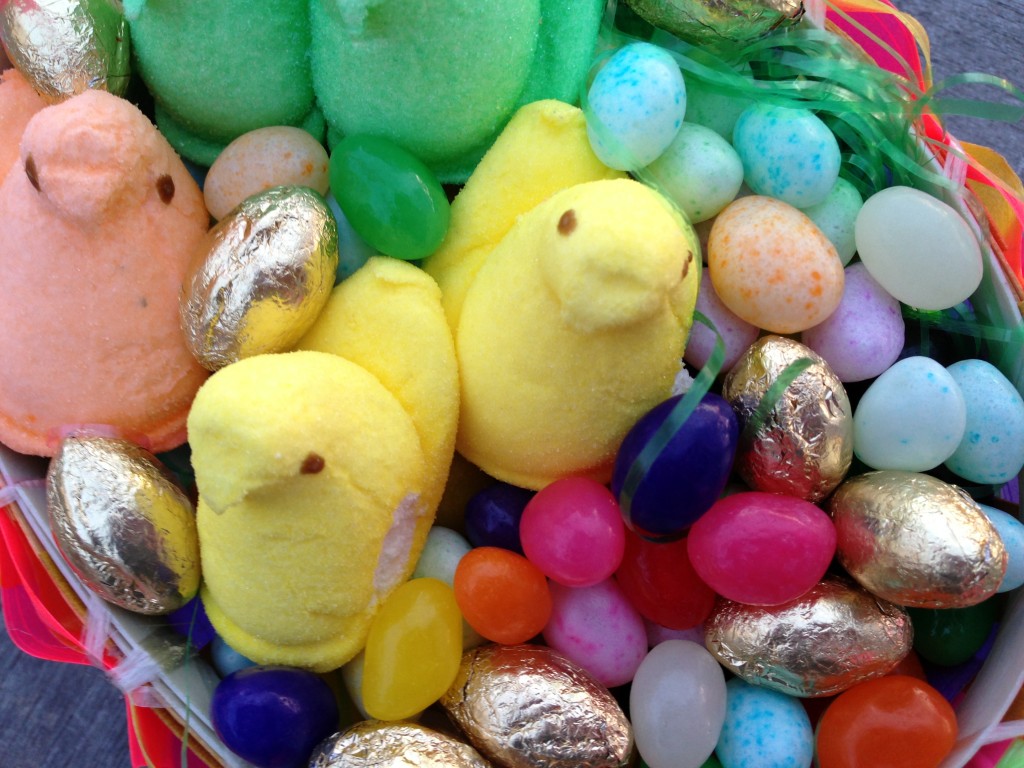
Standard jelly beans come in fruit flavors but there’s a huge number of flavors available — some goofy, some sophisticated — like spiced, mint, gourmet, tropical, popcorn, bubble gum, pepper, and cola.  They also come in a sugar free version (seems weird, but true).

Whatever your flavor preference, Americans eat a whole lot of jelly beans – around 16 billion at Easter — enough to circle the globe nearly three times if all the Easter jellybeans were lined up end to end.

Handfuls Or One By One, And What Flavor?

Do you go for handfuls at a time or pick and choose your colors and eat them one by one?

  • 70% of kids ages 6–11 prefer to eat Easter jellybeans one at a time
  • 23% say they eat several at once
  • Boys (29%) are more likely to eat a handful than girls (18%)
  • Kids say their favorite Easter jellybean flavors are cherry (20%), strawberry (12%), grape (10%), lime (7%), and blueberry (6%).

What’s In The Hard Shelled Nugget Of Sweetness?

Jelly beans are primarily made of sugar and also usually contain gelatin (Jelly Bellies don’t), corn syrup, modified food starch, and less than 0.5% of citric acid, sodium citrate, artificial flavors, confectioners glaze, pectin, carnauba wax, white mineral oil, magnesium hydroxide, and artificial colors (takes some of the fun out of them, doesn’t it?).

Even though they may give you Technicolor insides, they are fat free.  On average:

  • 10 small jelly beans (11g) have 41 calories, no fat, no cholesterol, no protein, and 10.3 grams of carbs
  • 10 large jelly beans (1oz or 28g) have 105 calories, no fat, no cholesterol, no protein, and 26.2g carbs
  • Jelly Bellies have 4 calories in each bean, or about 100 calories in a single serving (25 beans)
with approximately 1 gram of carbohydrate per bean and no fat.

Jelly Belly Jelly Beans

  • Jelly Bellies were invented in 1976. They were the first jelly beans to be sold in single flavors and to come with a menu of flavor choices.
  • It takes 7 to 21 days to make a single Jelly Belly jelly bean.
  • Very Cherry was the most popular Jelly Belly flavor for two decades until 1998, when Buttered Popcorn took over. Very Cherry moved back into the top spot by only 8 million beans in 2003.
  • Some jelly beans do contain gelatin, Jelly Bellies don’t and, according to the Jelly Belly website, are suitable for vegetarians although strict vegans may have issues with the beeswax and shellac that used to give them their final buff and polish.
  • Jelly Belly doesn’t use wheat, rye, barley, or oats in the basic recipe for Jelly Belly jelly beans but does use cornstarch as the modified food starch.
  • Jelly Belly beans have been certified kosher for the last two decades by the Kashrut supervision of KO Kosher Service.  Since 2007 all Jelly Belly products have been certified by the Orthodox Union.
  • Also Kosher: Teene Beanee Jelly Beans and Just Born Jelly Beans are Pareve and OU.

Easter Candy Tally
Eating 25 small jelly beans, 5 Peeps, a 1 3/4 ounce hollow chocolate bunny, and 1 Cadbury Creme Egg, which is not an unusual amount of Easter candy, tallies 730 calories.

You’d need to walk 7.3 miles, 11.77 kilometers, or 14600 steps, assuming you cover one mile in 2,000 steps to walk off that number of calories.  Sounds like a lot, but very doable over a few days.


Filed Under: Calorie Tips, Healthy Eating, Food Facts, Food for Fun and Thought, Holidays, Snacking, Noshing, Tasting Tagged With: Easter, Easter candy, holiday, jelly beans, Jelly Bellies

Where’s My PEEPS?

March 23, 2013 By Penny Klatell, PhD, RN Leave a Comment

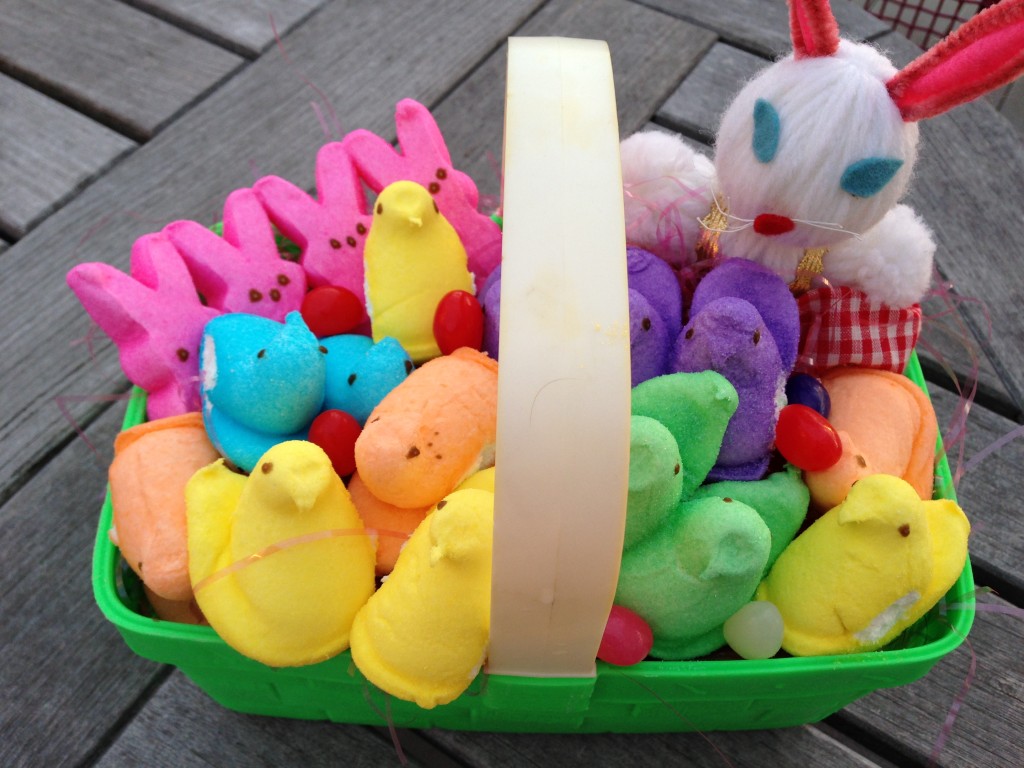
Do you have a thing for those fluorescent marshmallow bunnies and chicks that were hatched over 50 years ago? They got their name – PEEPS — because they were originally modeled after the yellow chick.  Now they’re made for Christmas, Halloween, and Valentine’s Day, too  — so you can get them in yellow pink, blue, lavender, orange, and green shapes that represent the different holidays. They come chocolate dipped, too.

PEEPS continue to be the subject of lots of design contests (you’d be amazed what you can make out of peeps) and scientific experiments (some claim them to be indestructible). Just Born, the parent company of PEEPS, claims to produce enough PEEPS in one year to circle the Earth twice. Their website even boasts a fan club and a section for recipes.

Do You Like Your PEEPS Soft Or Crunchy?

People have definite PEEPS preferences. Some like them nice and soft, others like to leave them out in the air to age to perfection so they get a little crunchy on the outside.

They’ve been microwaved (careful, they expand and can really make a mess in your microwave), frozen, roasted, used to top hot chocolate, and added to recipes. But they don’t toast well on sticks like regular marshmallows because their outer sugar coating tends to burn.

Millions of Peeps

During the Easter season Americans buy more than 700 million PEEPS that are shaped like chicks, bunnies and eggs although the iconic yellow PEEP is still the most popular choice.

As many as 4.2 million PEEPS can be made daily.  In 1953 it took 27 hours to create a PEEP.  It takes six minutes today.

Newspapers have been known to run contests for best PEEP recipes and best PEEP pictures, and, in a world of contrasts I’ve spotted a blackboards outside of bars in NYC advertising PEEP contests and a kids’ stores using boxes and boxes of PEEPs for window decorations.

What’s In Them?

Send a PEEP for lab analysis and you’ll find sugar, corn syrup, gelatin, less than 0.5% of potassium sorbate, natural flavors, dye, and carnauba wax.  They’re gluten and nut free but are not Kosher.  (No wonder some claim that they’re indestructible!) You can even get sugar free PEEPS that are made with Splenda.

If PEEPS are part of your Easter ritual, even though they’re filled with sugar and all kinds of dyes and chemicals, for a seasonal treat, calorically you could do worse.

Five little chicks (42g, one serving size) will set you back 140 calories; 0g fat; 1g protein; and 36g carbs.

Easter Candy Tally

Eating 25 small jelly beans, 5 Peeps, a 1 3/4 ounce hollow chocolate bunny, and 1 Cadbury Creme Egg, which is not an unusual amount of Easter candy, tallies 730 calories.

You’d need to walk 7.3 miles, 11.77 kilometers, or 14600 steps, assuming you cover one mile in 2,000 steps to walk off that number of calories.  Sounds like a lot, but very doable over a few days.
 

Filed Under: Calorie Tips, Healthy Eating, Food Facts, Food for Fun and Thought, Holidays, Snacking, Noshing, Tasting Tagged With: Easter, Easter candy, holiday, iconic treats, Peeps

Chocolate Eggs And Bunny Ears

March 20, 2013 By Penny Klatell, PhD, RN Leave a Comment

It’s time for pretty chocolate eggs nesting in baskets, bunnies and ducks in all shades of chocolate, and brightly wrapped candy stuffed in plastic eggs for Easter egg hunts.  Couple that with chocolate smeared over little kids’ faces and indestructible fluorescent peeps molded into weird shapes before they’re popped in your mouth.

It’s Easter candy time.  Admit it – Easter candy is seductive.  How can you not break off the chocolate bunny ears or eat your way through a basket of mini-chocolate Easter eggs?

If you’re going to indulge — and sometimes it’s worth it — you might as well know a little about your chocolate Easter candy.

Ninety million chocolate Easter bunnies are made every year.  76% of Americans think that chocolate bunnies should be eaten ears first, 5% think bunnies should be eaten feet first, and 4% like to eat the tail first. Despite the virtues of dark chocolate, 65% of adults prefer milk chocolate.

Easter Eggs – the Confectionary Type

Chocolate eggs can be found in all sizes and at every price point.  Some are piped with flowers and others are wrapped in foil.  You find them in chain stores, discount stores, and at high-end chocolatiers. Easter is ranked second for holiday for candy purchases in the US (just behind Halloween) and solid, hollow, and filled chocolate Easter eggs are one of the most popular choices.

Although John Cadbury made the first French Eating Chocolate in 1842, Cadbury Easter Eggs didn’t arrive until 1875. They’re a far cry from today’s Cadbury Crème egg (which now also comes with caramel, chocolate, and butterfinger fillings). Cadbury Dairy Milk Chocolate appeared on the market in 1905 and helped boost the sale of chocolate Easter eggs. Today’s chocolate Easter eggs are predominantly solid, hollow, decorated, and filled milk chocolate.

A Cheat Sheet For Popular Chocolate Easter Eggs (and a bunny)

As tough as it may be to admit, chocolate is a high calorie, high fat food.  Hershey says that nearly all of its chocolate products have been certified Kosher by the OU (Union of Orthodox Jewish Congregation). Here’s a cheat sheet for some of the most popular chocolate eggs:

  • Hershey’s Cadbury Chocolate Crème Easter Egg:  1 egg (39g), 180 calories, 8g Fat (5g saturated), 25g carbs, 2g protein
  • Hershey’s Cadbury Crème Egg, original milk chocolate with soft fondant crème center:  1 egg (39g), 170 calories, 6g fat (3.5g saturated), 28g carbs,  2g protein
  • Hershey’s Cadbury Mini Egg:  solid milk chocolate eggs with a crispy sugar shell: 12 eggs (40g), 200 calories, 9g fat(5g saturated), 28g carbs, 2g protein
  • Hershey’s Milk Chocolate Eggs:  7 pieces, 200 calories, 12g fat (7 saturated), 24g carbs, 3g protein
  • Dove Silky Smooth Milk Chocolate Eggs: 6 eggs, 240 calories, 14g fat (8g saturated), 26g carbs, 3g protein
  • Dove Rich Dark Chocolate Eggs:  6 eggs (43g), 220 calories, 14g fat (8 saturated), 26g carbs, 2g protein
  • Reese’s Milk Chocolate and Peanut Butter Eggs:  5 pieces (38g), 190 calories, 12g fat (6 saturated), 21g carbs, 4g protein
  • M & M’s Milk Chocolate Speck-Tacular Eggs: 1/4 cup (12 pieces): 210 calories, 10g fat (6 saturated), 29g carbs, 2g protein
  • Solid Milk Chocolate Easter Bunny:  2.5 oz, calories: average 370

But Isn’t Chocolate Good For Me?

The health benefits in chocolate come from cocoa. Dark chocolate has a greater concentration of cocoa than milk chocolate.  White chocolate, without any cocoa in it, isn’t really chocolate.

Chocolate, especially dark chocolate, can be heart healthy if it replaces an unhealthy, high calorie snack, but there’s still no recommended amount to eat to get the health benefits.

The Bottom Chocolate Line

Chocolate, especially dark chocolate, contains flavonols which have antioxidant qualities and other positive influences on heart health. Just remember that those delicious, pastel wrapped chocolate Easter eggs are caloric and moderately high in fat, one-third of it the type of saturated fat that isn’t heart healthy.

Extra ingredients like crème and caramel fillings can add lots of extra fat and calories. There’s no recommended serving size of chocolate to help gain cardiovascular benefits. If you’re going to choose a sweet treat, chocolate — especially dark chocolate with a high cocoa concentration — might be a healthier choice than other types of sweets.

Easter Candy Tally

Eating 25 small jelly beans, 5 Peeps, a 1 3/4 ounce hollow chocolate bunny, and 1 Cadbury Creme Egg, which is not an unusual amount of Easter candy, tallies 730 calories.

You’d need to walk 7.3 miles, 11.77 kilometers, or 14600 steps, assuming you cover one mile in 2,000 steps to walk off that number of calories.  Sounds like a lot, but very doable over a few days.

Up next: jelly beans and peeps.  What’s your favorite?

Filed Under: Calorie Tips, Healthy Eating, Food Facts, Food for Fun and Thought, Holidays, Manage Your Weight, Snacking, Noshing, Tasting Tagged With: calories in chocolate bunnies, calories in Easter chocolate candy, chocolate Easter eggs, Easter, Easter candy, holiday

Why Is There A Cross Cut Into The Top Of Irish Soda Bread?

March 15, 2013 By Penny Klatell, PhD, RN Leave a Comment


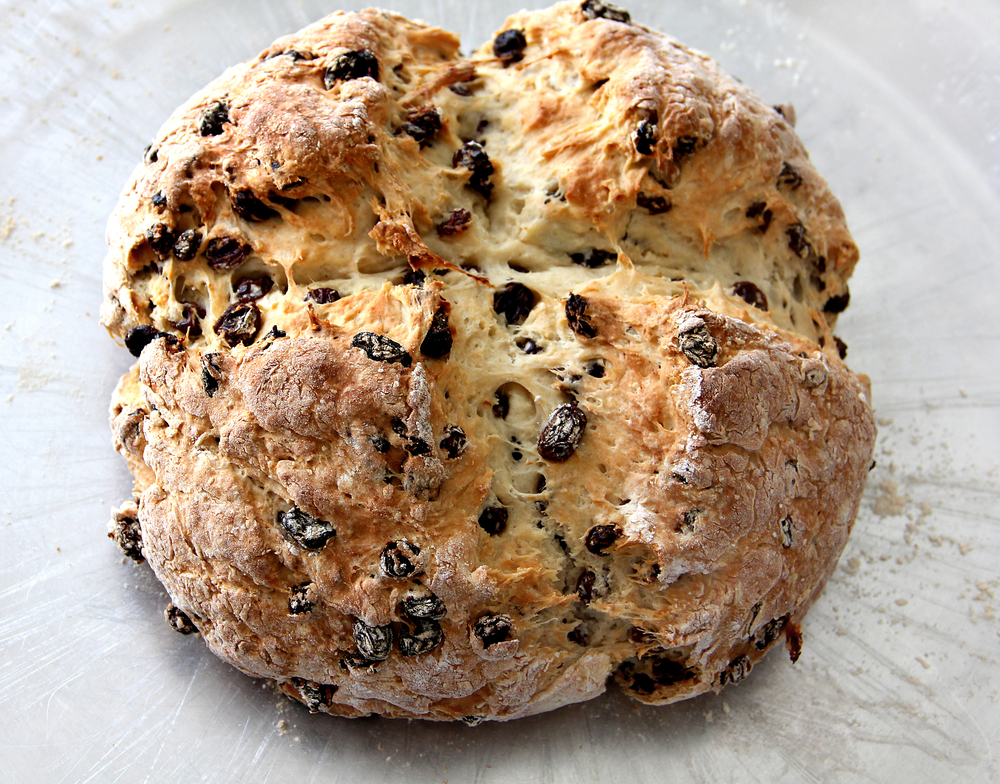
A loaf of Irish Soda Bread with raisins on baking sheet.

Look anywhere on St. Patrick’s Day in the US and you’re likely to find green bagels, beer, and even green McDonald’s milkshakes. You’ll also find “Irish soda bread” — with a cruciform slashed on top.  Why the shape of the cross – and why is it known as soda bread?

Thank The American Indians For Soda Bread

 The chemical reaction that makes soda bread wasn’t invented by the Irish.  Credit the American Indians who, centuries before soda bread became popular in Ireland, added pearl-ash (potash), the natural soda in wood ashes, to make their breads rise.

Soda bread became popular in Ireland when bicarbonate of soda, also known as bread soda, became available to use as a leavening agent.  Bread soda made it possible to work with the “soft” wheat grown in Ireland’s climate. “Hard” wheat flour, the main kind used in the US today, needs yeast to rise properly. “Soft” wheat flour doesn’t work well with yeast but is great for “quick breads” like soda bread.

According to The Society for the Preservation of Irish Soda Bread the earliest published soda bread recipe was in a London magazine in 1836 – also later repeated in several US papers – that references a “receipt for making soda bread” found in a newspaper in Northern Ireland. The praise:  “there is no bread to be had equal to it for invigorating the body, promoting digestion, strengthening the stomach, and improving the state of the bowels.” Sounds like tasting good wasn’t a big priority!

In 19th century Ireland, making bread was part of daily life and most families lived in farmhouses where kitchens had open hearths, not ovens. Bread soda meant that anyone who didn’t have an oven (most people in Ireland in the 1800’s didn’t) could make soda bread.

The bread soda wasn’t perishable, was relatively inexpensive and buttermilk, a by-product of making butter, and the soft wheat for flour, both necessary components of soda bread, were commonly available. The bread was cooked on a griddle or in a bastible, a big cast-iron pot with a lid that could be put right into coals or a turf fire.

Brown Or White; Cake Or Farl

“Plain” soda bread often appears with a main meal  — to soak up gravy – or at breakfast. It comes both brown and white, and in two main types, cake and farl.

Traditional brown Irish soda bread is basic table bread made from whole meal flour, baking soda (bread soda), salt, and buttermilk.  White soda bread, made with white flour, is considered slightly more refined than brown soda bead and is sometimes considered a more special occasion bread.

Cake tends to be found more in the south of Ireland while people in Northern Ireland seem to prefer farl — although both can be found in the North and South, sometimes with different names.

Cake is soda bread that is kneaded, shaped into a flattish round, then deeply cut with a cross on the top.  Now it’s normally baked in an oven.

For farl the dough is rolled into a rough circle and cut all the way through — like a cross — into four pieces or farls (“farl” is a generic term for a triangular piece of baking).  It’s usually baked in a heavy frying pan, on a griddle, or on top of the range or stove. It’s flatter and moister than cake.  Each farl is split in half “the wide way” before it’s eaten and is best when hot. It’s also allowed to cool and then grilled or fried as part of other dishes — especially the Ulster Fry,  a local breakfast where golden and crispy soda bread and potato farls have been fried in reserved bacon fat and are served with Irish bacon, sausage, black pudding, tomato and egg.

What’s Spotted Dog?

There are regional variations of the basic soda bread recipe – even though some purists would say there should be no additions to the dough.

In Donegal caraway seeds were traditionally put in the bread.  In earlier and leaner times when raisins or dried fruit were luxuries, a fistful of them or maybe even a little sugar or an egg — if either could be spared — would have been put into the white flour version of the bread during the harvest as a treat for the working men.

The non-traditional varieties of soda breads that are made with raisins, caraway, orange zest, and other add-ins are often called Spotted Dog.

What About The Cross On Top?

Before baking, a cross is traditionally cut on the top of the soda bread loaf with a knife – often said to ward off the devil and to protect the household.

Legend and symbolism aside, there’s a practical reason for the cruciform shape to be cut into the top of the dough. Slashing the dough lets heat penetrate into the thickest part of the bread and allows the bread to stretch and expand as it rises.

Slashing a round loaf with a cruciform shape ends up dividing the bread into quadrants that can be easily broken apart (the breaking of the bread). But, since Ireland is a Catholic country, the symbolism of the cross can also be interpreted as blessing (crossing) the bread and giving thanks.

Nutrition

1 serving (74 g) of Irish Soda Bread with raisins and caraway seeds:

  • 214 calories, 3.67g fat, 41.51g carbs, 4.86g protein

Filed Under: Calorie Tips, Healthy Eating, Food Facts, Food for Fun and Thought, Holidays, Shopping, Cooking, Baking Tagged With: bread soda, farl, holiday bread, Irish soda bread, pearl-ash, soda bread, Ulster fry

5 Things You Probably Don’t Know About Valentine’s Day

February 12, 2013 By Penny Klatell, PhD, RN Leave a Comment

1. When Did We Start Exchanging Valentines?

Valentine greetings were popular as far back as the Middle Ages. The first commercial Valentine’s Day cards in the US were created in the 1840s. British Valentine’s Day celebrations started around the 17th century and by the middle of the 18th century all social classes exchanged tokens of affection or handwritten notes. Americans probably began exchanging handmade valentines in the early 1700s and mass-produced valentines in the 1840s.

2.  Who was Saint Valentine?

The Catholic Church recognizes at least three different martyred saints named Valentine.  All of their stories emphasize Valentine’s sympathetic, heroic, and romantic appeal.

In one, a priest in 3rd century Rome defied Emperor Claudius’ decree outlawing marriage for young men and continued to perform secret marriages — for which he was put to death. Another story suggests that Valentine was killed because he tried to help Christians escape harsh Roman prisons. And in another legend the imprisoned Valentine sent the first “valentine” message, a letter, to his jailor’s daughter signing it “from your Valentine.”

Some people think that Valentine’s Day is celebrated in the middle of February to commemorate Valentine’s death around 270 A.D.  Others think the Christian church decided to celebrate Valentine’s feast day in the middle of February in an attempt to “christianize” the pagan Lupercalia, known as the beginning of spring festival.

3.  Why Is The Symbol For Valentine’s Day A Red Heart?

No one seems to be really sure why the heart shape symbolizes love, but there’s some speculation that it might have to do with a rare, now extinct North African plant called silphium which was mostly used for seasoning but also had off-label use as a form of birth control. In the 7th century BC the city-state of Cyrene had a lucrative trade in it and minted coins that showed the plant’s seedpod, which looked like the heart shape we know today. The theory goes that’s the reason the heart shape first became associated with sex and then with love.

But the Catholic Church contends that the modern heart shape became symbolic in the 17th century when Saint Margaret Mary Alocoque envisioned it surrounded by thorns. It became known as the Sacred Heart of Jesus and the popularized shape became associated with love and devotion.

There’s also a school of thought that the modern heart shape came from botched attempts to draw an actual human heart, the organ the ancients, including Aristotle, thought contained all human passions. It was described as a three-chambered organ with a rounded top and pointy bottom, which might have been the inspiration for medieval artists to create what we now know as the heart shape.

Red is traditionally associated with the color of blood. Since people once thought that the heart, which pumps blood, was the part of the body that felt love, the red heart (legend says) has become the Valentine symbol.

 4.  Where Does “Sweets To The Sweet” Come From?

We have Hamlet’s mother, the Queen (via Shakespeare), to thank. The phrase refers to the funeral bouquets of flowers scattered over Ophelia’s grave (Hamlet’s former flame) — but the candy industry uses it to promote Valentine’s Day candy.

5.  Who Gets And Gives The Most Stuff On Valentine’s Day?

Valentine’s Day is the fourth in line for holiday candy sales after Halloween, Easter, and Christmas. 52.1% of people buy cards, the most popular Valentine’s Day gift. Women buy about 85% of an estimated one billion Valentine cards that are sent each year.

Around 36 million heart-shaped boxes of chocolate are sold and a survey by the Chocolate Manufacturers Association showed that 50% of women most likely will give chocolate to a guy for Valentine’s Day.

If you’ve ever wondered who gets the most Valentine’s Day candy and gifts, you might be surprised to learn that kids are the winners getting 39% of all Valentine’s Day candy and gifts. They’re followed by wives and mothers at 36%, fathers and husbands at 6%, and grandparents at 3%.

And, not to overlook other members of our households, more than nine million pet owners buy their pets gifts with the average person spending $5.04 on them.

Filed Under: Food for Fun and Thought, Holidays Tagged With: heart as a symbol, holiday, Valentine's Day, Valentine's Day candy, Valentine's symbol

  • « Go to Previous Page
  • Go to page 1
  • Interim pages omitted …
  • Go to page 21
  • Go to page 22
  • Go to page 23
  • Go to page 24
  • Go to page 25
  • Interim pages omitted …
  • Go to page 40
  • Go to Next Page »

Primary Sidebar

Recent Posts

  • Buy Me Some Peanuts And Cracker Jacks
  • Is Your Coffee Or Tea Giving You A Pot Belly?
  • PEEPS: Do You Love Them or Hate Them?
  • JellyBeans!!!
  • Why Is Irish Soda Bread Called Soda Bread or Farl or Spotted Dog?

Topics

  • Calorie Tips, Healthy Eating, Food Facts
  • Eating on the Job
  • Eating with Family and Friends
  • Entertaining, Buffets, Parties, Events
  • Food for Fun and Thought
  • Holidays
  • Lose 5 Pounds in 5 Weeks
  • Manage Your Weight
  • Restaurants, Diners, Fast Food
  • Shopping, Cooking, Baking
  • Snacking, Noshing, Tasting
  • Takeout, Prepared Food, Junk Food
  • Travel, On Vacation, In the Car
  • Uncategorized

My posts may contain affiliate links. If you buy something through one of the links you won’t pay a penny more but I’ll receive a small commission, which will help me buy more products to test and then write about. I do not get compensated for reviews. Click here for more info.

The material on this site is not to be construed as professional health care advice and is intended to be used for informational purposes only.
Copyright © 2024 · Eat Out Eat Well®️. All Rights Reserved.