• Skip to secondary menu
  • Skip to main content
  • Skip to primary sidebar

Eat Out Eat Well

  • Home
  • About
  • Eats and More® Store
  • Books
  • Contact

eat out eat well

Eater Alert: Beware End Of Summer Gluttony

August 31, 2010 By Penny Klatell, PhD, RN Leave a Comment

It’s the week leading up to Labor Day weekend.  Not technically the end of summer, but it sure feels that way.

I don’t know about you, but for me the thought process seems to be:  “Oh heck, it’s the last week of summer, the holiday weekend is coming up, all of my family is going to be home, a lot of burgers, ice cream, picnic food – and then it’s nose to the grindstone” (even if it has been nose to the grindstone, as it has been for me, most of the summer).

Holidays And Vacations Often Mean Overeating

It’s the kind of holiday season mentality that starts around Thanksgiving and continues right through New Year’s Day when you swear you’ll never eat another carb again!

Or, it’s the “vacation” mentality, when all of your healthy eating promises become submerged in the deepest recesses of your brain.

Or, it’s the mentality that adds the “freshman 15 . . . or 5 . . . or 10,”  the freedom at last, away from home mentality where no food is off limits.

Four Weeks Of Overeating:  Changes That Last For Years

Some new research may make you think twice.  Amazingly, overeating for just four weeks can cause changes in body fat and weight that last for years. For four weeks people in a study limited their activity to 5,000 steps a day or less (considered a sedentary lifestyle) and increased their caloric intake by 70% (5000+ calories a day). For two years researchers periodically monitored body weight and composition in this group and compared it to another group that did not change its diet or physical activity.

How Much Weight Gain?

The overeater/under-exerciser group gained, on average, 14 pounds. Six months after they were allowed to go back to eating and exercising normally they lost, on average, 71 percent of the gained weight but only one-third of the group members had returned to within one pound of their initial weight.

After one year the overeaters were, on average,  3.3 pounds heavier than before their four week food fest. The normal eaters had no change in body weight.

The overeaters had more body fat and higher LDL (lousy) cholesterol levels one year after their four week binge.  After two and a half years, the overeaters averaged a gain of 6.8 pounds from when the study first started, but the normal eaters didn’t show any significant weight gain.

SocialDieter Tip:

Boy oh boy, the effects of gluttony are really hard to get rid of – even when those overeating habits are ditched for a healthy lifestyle.  Even short periods of overeating and under-exercising can have lasting effects and make it more difficult to lose weight and keep it off.  Keep that in mind around holiday time, vacations, and “let-down-your-hair” times leading up to holidays and vacations.  It’ll serve you well for years to come.

Filed Under: Calorie Tips, Healthy Eating, Food Facts, Eating with Family and Friends, Entertaining, Buffets, Parties, Events, Manage Your Weight, Snacking, Noshing, Tasting, Travel, On Vacation, In the Car Tagged With: calories, celebrations, eat out eat well, overeating, weight gain

Are You Going To Cook That Or Do A Chemistry Experiment?

August 24, 2010 By Penny Klatell, PhD, RN Leave a Comment

Do you watch Top Chef?  I do.  I also watch Top Chef Masters.  And, because I happen to live in the New York City area, I’ve been fortunate enough to eat at wd—50, Wylie Dufresne’s restaurant in Manhattan. Dufresne, a contender on Top Chef Masters and a guest judge on Top Chef, is one of America’s most famous chefs who routinely uses molecular gastronomy in his food preparation.

What The Heck Is Molecular Gastronomy?

It’s a scientific discipline that studies the physical and chemical processes that happen during cooking.  According to Wikipedia, It tries to figure out things like:

  • How different cooking methods alter ingredients
  • What role the senses play in appreciating food
  • How cooking methods affect food’s flavor and texture
  • How the brain interprets signals from the senses to tell us the “flavor” of food
  • How things like the environment, mood, and presentation influence the enjoyment of food

“The Scientific Study Of Deliciousness”

This is how Harold McGee, author of  the book, On Food and Cooking: The Science and Lore of the Kitchen, describes MG. Gourmet Girl Magazine gives these examples of MG techniques:

  • Flash-freezing which involves quickly freezing the outside of various foods, sometimes leaving a liquid center.
  • Spherification: Little spheres are made by mixing liquid food with sodium alginate then dunking it into calcium chloride.  A sphere looks and feels like caviar and has a thin membrane that releases a liquid center when it pops in your mouth.
  • Meat glue: Wylie Dufresne’s “shrimp noodles” are noodles made of shrimp meat and created using transglutaminase, or meat glue, as it’s called at wd-50. It binds different proteins together and is commonly used in foods like chicken nuggets.
  • Foams: Sauces that are turned into froth by using a whipped cream canister, sometimes with lecithin as a stabilizer.
  • Edible menus: Yep, eat your menu. By using an ink-jet printer, inks made from fruit and vegetables, and paper made of soybean and potato starch, your menu can taste like your dinner.
  • Dusts and Dehydration: Dehydrating ingredients into a dust changes the way to use them, for example, making a dust of certain mushrooms and then sprinkling it on food.

The Bottom Line

According to Environmental Nutrition (EN), if you’ve wondered what makes glossy white peaks form when you whip egg whites, or how an ordinary milk can  turn into rich, pungent cheese, you’ve wandered into the world of molecular gastronomy (MG).

MG, “the scientific study of the pleasure giving qualities of foods—the qualities that make them more than mere nutrients,” analyzes long standing culinary practices and old wives’ tales and deconstructs classic recipes. As you lick that delicious ice cream cone do you stop and think about ice cream’s complicated physical structure that includes ice crystals, protein aggregates, sugar crystals and fats in a condensed form?  You don’t, but molecular gastronomists might.

What Does MG Look Like On Your Dinner Plate?

Grant Achatz, a James Beard award winning chef might serve these foods at Alinea, his Chicago restaurant: tiny bits of cauliflower served shaved, fried, dehydrated, and coated in three kinds of custards; Chinese beef and broccoli plated as a traditional short rib, the plate dotted with dehydrated broccoli and peanuts then covered with a clear gelatinous sheet of Guinness beer.

Got you thinking as you lick your lips?

Filed Under: Food for Fun and Thought, Restaurants, Diners, Fast Food Tagged With: cooking, eat out eat well, food for fun and thought, food prep, molecular gastronomy

Sometimes It’s Important To Eat Cake

August 17, 2010 By Penny Klatell, PhD, RN Leave a Comment

. . . And Enjoy Every Bit Of It

We celebrated my Mom’s 90th birthday this past weekend.  Actually, she has three birthdays – the one on her birth certificate and driver’s license (yes, she still drives), one on her baptismal certificate, and a third that doesn’t appear on anything other than innumerable birthday cards. No explanation for this.

As you can see above, my Mom’s name is Virginia.  This is notable because she is one of thirteen children – and the other 12 all have names like Mary, Helen, and John.  Why Virginia?  “I’m named after the undertaker’s wife,” she said.  Thanks, Mom.  Any other strange bits of trivia hanging around the family tree?

Mom wanted to celebrate her birthday at her family’s annual reunion – with her six living siblings and lots of other family.  Okay, doesn’t everyone drive 3 and ½ hours for lunch?  Off we went with a couple of surprise “picture” cakes hidden in the trunk of the car.

And a surprise it was.   She was delighted – and it showed.  And it was so worth the searching through boxes of pictures, picking up the cakes, and the drive.

Sometimes Celebrations Outweigh The Calories

We eat cake for lots of reasons.  It just may taste delicious.  Maybe it’s your favorite food.  Or, maybe you avoid it like the plague because of calories, fat, sugar, and white flour.  All legitimate reasons if they’re your reasons.

But, there are times when celebrations are important, really important – weddings, baptisms, engagements, holidays, and birthdays, to name a few.  Even funerals and memorial services are often followed by food — and cake — because food is a way of bringing together friends and family.

What’s So Important About The Cake?

Special celebration cakes are designed, made, ordered, and eaten with love.  Sometimes they taste good, sometimes they don’t.  Sometimes “diets” get in the way of the meaning of the cake. Sometimes the regimentation of an eating plan gets in the way of the reason for a celebration.

Sometimes cakes are just cakes – like the ones that sit in the multi-shelved dessert display at the diner.  Those are not celebration cakes.  But the lopsided one that your child makes for you on Mother’s Day, or the multi-tiered one at your or your child’s wedding, or the one for your Mom’s 90th birthday are very special.

So have a small piece (or a big one if you want) – or eat only a couple of  forkfuls.   Or, if you’re like my cousin, gleefully eat the corner piece (of a rectangular cake) because it has the most icing.

How would you feel if it’s your birthday or wedding and you hand some of your special cake to a friend who says, “No thanks, I’m on a diet”?

Sometimes it’s important to eat cake.

Filed Under: Eating on the Job, Eating with Family and Friends, Entertaining, Buffets, Parties, Events, Food for Fun and Thought, Manage Your Weight, Shopping, Cooking, Baking, Snacking, Noshing, Tasting Tagged With: cake, celebrations, desserts, eat out eat well, holidays, meaning of food, weight management strategies

Do You Eat Because You Are Hungry?

August 13, 2010 By Penny Klatell, PhD, RN Leave a Comment

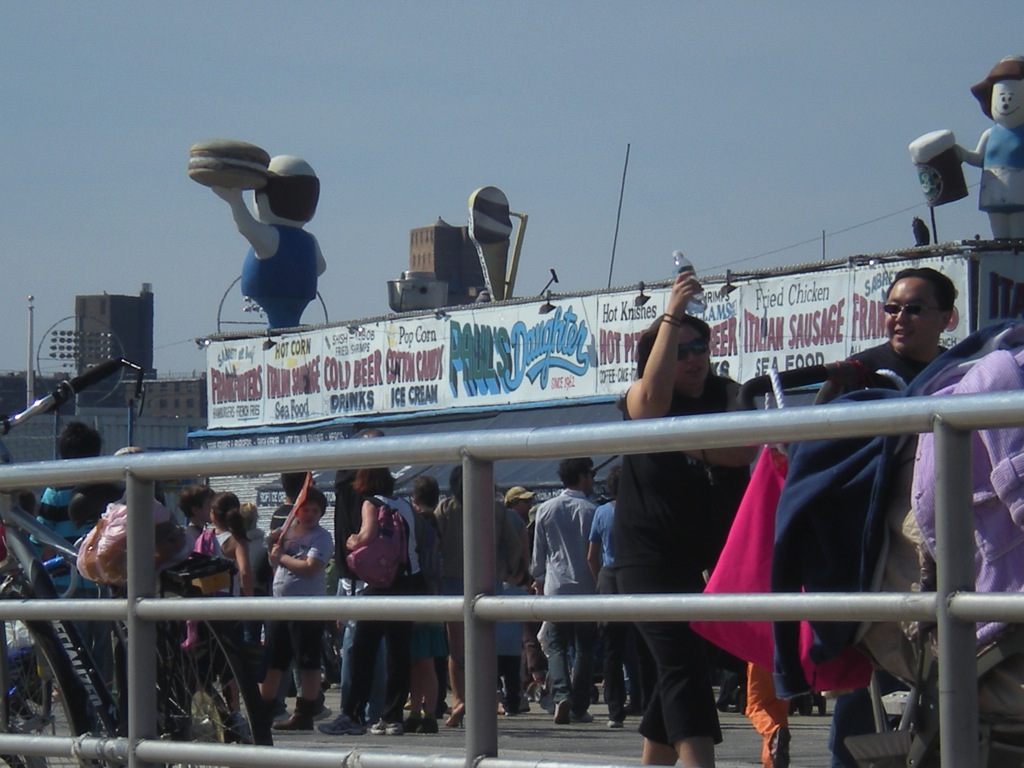
Coney Island Boardwalk, Brooklyn, NY

Are You Really Hungry?

It’s summertime and the living is easy.  Picnics, barbecues, a sandwich at the beach are often the order of the day. And what about the ice cream cone, the beer with the burger, the peach pie, and the toasted almond from the Good Humor truck?  Vacation often means sun, sand, and eating – whenever. Living is easy, unstructured, and calorically dangerous.
Vacations and free and easy summer days spawn classic scenarios for mindless versus mindful eating.  Mindless eating often happens when there is no “structure” and a lack planning – when you give into “head hunger” as opposed to actual physical hunger.  When you’re faced with groaning buffet tables, holiday spreads with food on every flat surface, and endless passed hors d’oeuvres at an outdoor wedding, do you have a clue about how much – or even what — you have popped in your mouth?

Why Do You Mindlessly Eat?

Hunger doesn’t prompt most people to overeat. Instead, overeating situations are usually created by family, friends, plate size, packaging, lighting, candles, smells, distractions, environments, and feelings.  According to the Mindless Eating website, two studies show that the average person makes about 250 food decisions every day – like deciding between white or whole wheat; sandwich or salad; grilled chicken or tuna; half or whole; kitchen table or chair in front of the TV.  That’s about 250 daily opportunities to be mindful or mindless.

What’s Different About Mindful Eating?

Mindful eating means avoiding the shove it in your mouth, non-thinking kind of eating and encourages slower, more fully focused eating based on hunger and your body’s need for food.  Armed with a plan rather than attacking whatever is edible, you choose carefully, eat more slowly, and savor your food  — not gobbling it as part of multi-tasking, grab and go, or a race to the finish line.
Mindful eating doesn’t mean eating with your back straight, elbows off the table, using the correct fork.  It means being mindful:  conscious and aware of your choices and your food. You can eat anywhere and be mindful – mindfulness and a plan for what and how much you eat are not dependent on your kitchen table or a restaurant menu.  You can be mindful at the beach, at a street fair, and at the office, too.

Table Setting For Lunch, Tuscany, Italy

Stomach Versus Head Hunger

Mindless eating is often prompted by head hunger while mindful eating is largely associated with stomach hunger.
Head hunger is the compulsion to eat when your body isn’t physically hungry — often in response to a learned behavior:  i.e., it’s noontime so I have to eat, doesn’t matter how I feel or if I’m hungry. Head hunger comes on suddenly and often takes the form of cravings, eating when you’re not hungry, eating when you think you should be eating, and mindless snacking. It happens at any time, with no physical symptoms, and includes time cues and sensory triggers, like smell, taste, or texture.  Obsessing about food, habits (like watching TV, working on the computer, or driving), emotional or personal triggers, and cravings can make you think that you’re hungry when you’re really not.

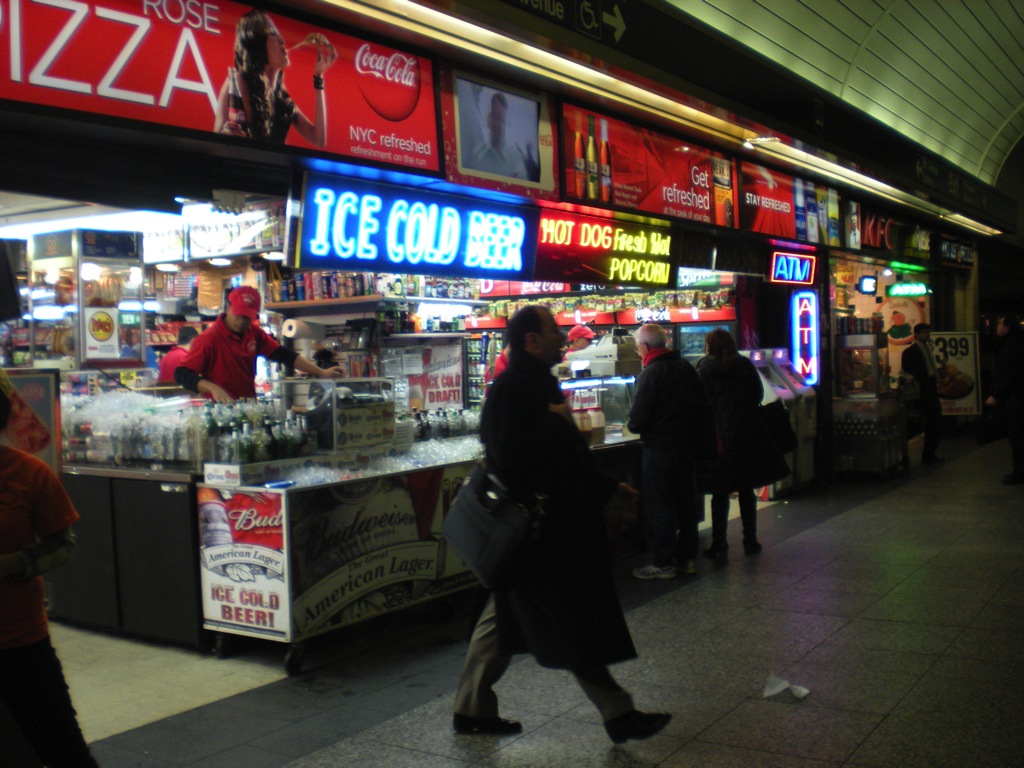
Penn Station, NYC

Physical hunger, or stomach hunger, comes on slowly and usually happens two to four hours after you’ve last eaten. With true stomach hunger you may have an empty or grumbling stomach, lightheadedness, hand tremors, fatigue, or a headache.  It’s your body’s way of telling you that it needs fuel and that it’s time to eat.  You’re usually satisfied with almost anything – unlike the frequent cravings for sugar, salt, fat that occur with head hunger.

SocialDieter Tip:

Head hunger will eventually go away if you ignore it.  Your body is not telling you it needs food for sustenance, rather, your head is talking to you, sometimes quite loudly. With head hunger, try to put off grabbing some food by distracting yourself and ignore it until it goes away.  Often a cup of tea or coffee or a glass of water will do the trick as well as some distracting behavior. If your head hunger is screaming at you it may be tough to ignore.  If you need to eat something ask yourself when you last ate.  If it’s approaching three hours you might be physically hungry in which case you can’t ignore it and it won’t lessen with time. When you eat mindfully you are aware of stomach (physical) hunger versus head (emotional) hunger.  You tune into your body’s signals about what, when, and how much to eat, and when to stop eating because you are approaching full and not because your plate its empty.

Filed Under: Eating on the Job, Eating with Family and Friends, Entertaining, Buffets, Parties, Events, Manage Your Weight, Snacking, Noshing, Tasting Tagged With: eat out eat well, eating triggers, emotional eating, head hunger, hunger, mindful eating, mindless eating, weight management strategies

What Do You Eat With Your Movie?

August 6, 2010 By Penny Klatell, PhD, RN Leave a Comment

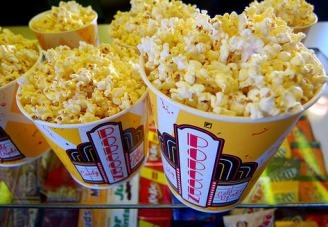
I went to the movies Saturday night.  It was a long, long day and I was tired – so my guard was down.  As I walked into the theater the first thing that hit me was the wafting and delicious smell of freshly popped (and it was freshly popped in this theater) popcorn. I could have had a label plastered across my forehead:  sucker coming around the corner, start filling the popcorn bag!  Elbow in my husband’s ribs:  buy some!

It was the first time I’ve had movie theater popcorn in about two years.  Not that I don’t love it – I do.  I also know a little bit about it.  Thing is, after writing another post about popcorn I even asked the guy behind the concession stand several months ago what they pop their popcorn in.  “Oh, I think it’s some combination of coconut oil and other stuff.”  Fat gram numbers spiraled and multiplied in my head. Yet, the siren call of freshly popped popcorn was too strong to overcome.

I Don’t Care, I’m Going To Have It Anyway

I had set myself up for a “I don’t care, I’m going to have it anyway” caloric splurge.  Why?  I was hungry, tired,  and it was the tail end of a very busy week.  And, two other important factors:  our friends had already bought their popcorn (ever sit next to someone who is eating something you really like and that smells delicious?) and I really love popcorn.

SocialDieter Tip:

I’m not suggesting that you – or I – should never have movie theater popcorn. What I am suggesting is that If you are going to have popcorn it should be figured into your overall caloric balance.  Popcorn today – lots of fruit and veggies the next day – or maybe earlier in the day.  The same thing is true if your weakness is that box of Raisinets – or Goobers – or Milk Duds.

Not the greatest foods in the world, but if you are going to have them as an occasional splurge build the splurge into your day – or weekly – food plan. If you’re going to eat the stuff, at least do it mindfully.  Oh – you could also not eat anything during the movie, it is only about two hours – or, you could bring some healthy snacks like a lower calorie protein bar or trail mix with you (a crunchy apple doesn’t lend itself to quiet eating).  And ditch the soda for plain old water.

FYI: Some Popular Movie Theater Snacks – And Their Calorie Counts

(Note the serving sizes, movie theater boxes of candy are often huge and may be double or triple the size shown below.)

Popcorn, Nachos, Soft Pretzel

  • Buttered popcorn, small, 5 cups:  470 calories, 35g fat
  • Buttered popcorn, large, 20 cups:  1640 calories, 126g fat
  • Cheese nachos, large (4 oz):  1100 calories, 60g fat
  • Soft pretzel, large (5 oz):  480 calories, 5g fat

Soda and Lemonade

  • Coke, small (18 oz:218 calories, 0g fat
  • Coke, large (44 oz):  534 calories, 0g fat
  • Minute Maid Lemonade (18 oz):  248 calories, 0g fat
  • Minute Maid Lemonade (44 oz):  605 calories, 0g fat

Candy

  • Junior Mints, 3 0z box:  360 calories, 7g fat
  • Sno Caps, 3.1 oz box:  300 calories, 15g fat
  • Milk Duds, 3oz box:  370 calories, 12g fat
  • Raisinets, 3.5 oz bag:  400 calories, 16g fat
  • Goobers, 3.5 oz box:  500 calories, 35g fat
  • Twizzlers, 6oz bag:  570 calories, 4g fat
  • M&Ms, 5.3oz bag:  750 calories, 32g fat
  • Peanut M&Ms, 5.3 oz bag:  790 calories, 40g fat
  • Reese’s Pieces, 8oz bag:  1160 calories, 60g fat

Filed Under: Calorie Tips, Healthy Eating, Food Facts, Manage Your Weight, Snacking, Noshing, Tasting, Takeout, Prepared Food, Junk Food Tagged With: calories, candy, eat out eat well, fat, food facts, mindful eating, mindless eating, movie theater, popcorn, snacks, weight management strategies

  • « Go to Previous Page
  • Go to page 1
  • Interim pages omitted …
  • Go to page 14
  • Go to page 15
  • Go to page 16
  • Go to page 17
  • Go to page 18
  • Interim pages omitted …
  • Go to page 20
  • Go to Next Page »

Primary Sidebar

Recent Posts

  • Buy Me Some Peanuts And Cracker Jacks
  • Is Your Coffee Or Tea Giving You A Pot Belly?
  • PEEPS: Do You Love Them or Hate Them?
  • JellyBeans!!!
  • Why Is Irish Soda Bread Called Soda Bread or Farl or Spotted Dog?

Topics

  • Calorie Tips, Healthy Eating, Food Facts
  • Eating on the Job
  • Eating with Family and Friends
  • Entertaining, Buffets, Parties, Events
  • Food for Fun and Thought
  • Holidays
  • Lose 5 Pounds in 5 Weeks
  • Manage Your Weight
  • Restaurants, Diners, Fast Food
  • Shopping, Cooking, Baking
  • Snacking, Noshing, Tasting
  • Takeout, Prepared Food, Junk Food
  • Travel, On Vacation, In the Car
  • Uncategorized

My posts may contain affiliate links. If you buy something through one of the links you won’t pay a penny more but I’ll receive a small commission, which will help me buy more products to test and then write about. I do not get compensated for reviews. Click here for more info.

The material on this site is not to be construed as professional health care advice and is intended to be used for informational purposes only.
Copyright © 2025 · Eat Out Eat Well®️. All Rights Reserved.