• Skip to secondary menu
  • Skip to main content
  • Skip to primary sidebar

Eat Out Eat Well

  • Home
  • About
  • Eats and More® Store
  • Books
  • Contact

Eating with Family and Friends

Boardwalks and Ballparks: What’s To Eat?

July 2, 2013 By Penny Klatell, PhD, RN Leave a Comment

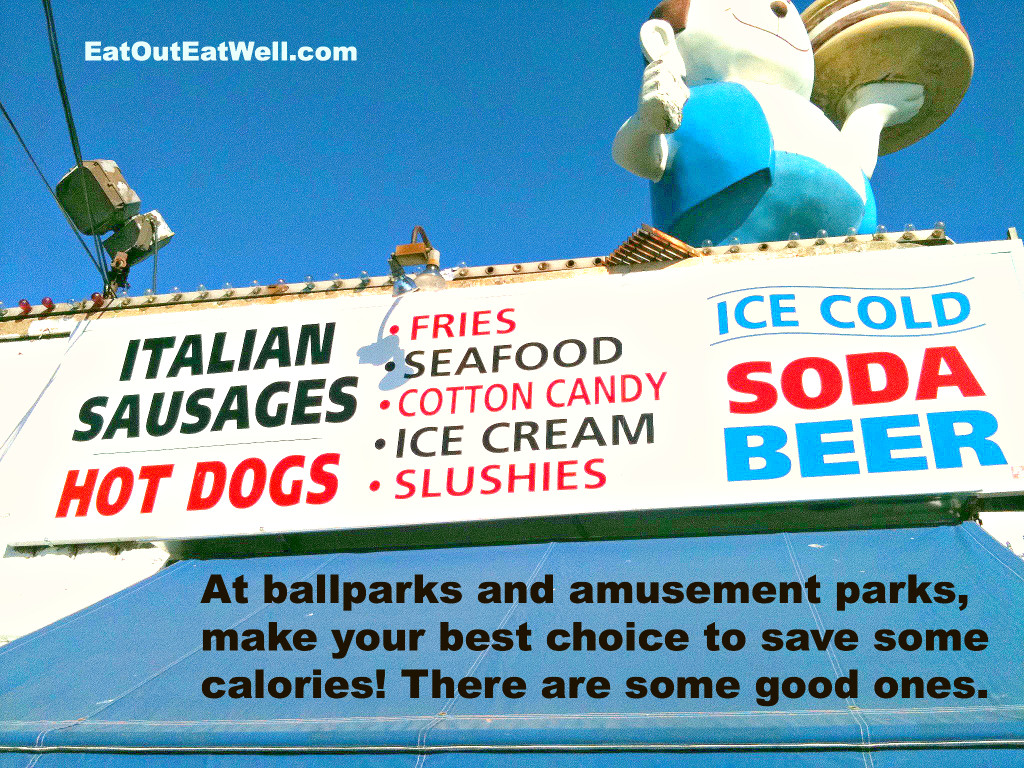
ballpark foodSports stadiums, amusement parks, state fairs and street fairs.  What do you usually do at these places – other than watch games and have a blast on the rides? EAT, of course!

Oh, the food!  Oh the calories! So how can you be calorie aware when there are food vendors about every 20 feet hawking dogs, ice cream, and fried everything?

There Are Ways And Then There Are Ways

If you’ve got a will of iron you could ignore the food and drinks.  But if you’re tempted at every turn, you can try to minimize the damage without taking away the fun.  If you know you’re going to be having a stadium or boardwalk meal, do some thinking, planning, and sleuthing.  The best choices are not always the obvious ones.

Do you need both peanuts and popcorn?  Can you make do with a regular hot dog instead of a foot-long?  Can you keep it to one or two beers instead of three?  Can you choose the small popcorn instead of the jumbo tub? Can you ditch the soda — or maybe the second one — and replace it with water?

Make Your Best Choice To Save A Few Calories

It’s all about choices. You can enjoy your day and make the best caloric choice (we’re not necessarily talking best nutritional choice) and still enjoy traditional ballpark and amusement park food.  Weigh your options – what’s your best choice?

  • Cotton Candy: Nothing but heated and colored sugar that’s spun into threads with added air. Cotton candy on a stick or wrapped around a paper cone (about an ounce) has around 105 calories; a 2oz. bag (common size) has 210. A lot of sugar, but not a lot of calories – albeit empty ones.
  • Funnel cake:  The fried dough wonder and staple of fairs, boardwalks, and amusement parks, funnel cake is made by pouring dough through a funnel into cooking oil and deep frying the “funnels” of dough until they’re golden-brown and crispy – then topping the pieces with powdered sugar, syrup, or honey.  Different cultures have varying versions of fried dough – sometimes it’s long strips and sometimes just round fried balls of dough. The calories vary enormously depending on the quantity and toppings.  Just remember, regardless of the shape, they’re all dough fried in oil topped with a sweetener.  That means high calories and low nutrition.  You probably have to figure a minimum of around 300 calories for a 6 inch funnel cake (do they ever come that small?). Onward and upward from there!
  • Good Humor Ice Cream:  Strawberry Shortcake Ice Cream Bar (83g):  230 calories; Toasted Almond (113g):  240 calories; Candy Center Crunch:  310 calories;  Low Fat Ice Cream Sandwich, vanilla:  130 calories
  • Cracker Jack (officially cracker jack, not jacks): candy-coated popcorn with some peanuts. A 3.5oz stadium size box has 420 calories but it does have 7g of protein and 3.5g of fiber.
  • Hamburger:   6oz. of food stand beef (they’re not using extra lean – the more fat, the juicier it is) on a bun has about 490 calories — without cheese or other toppings — which up the ante.
  • Grilled Chicken Sandwich, 6oz.:  280 calories – not a bad choice.  6oz. of chicken tenders clock in at 446 calories.  Barbecue dipping sauce adds 30 calories a tablespoon.
  • Hot Dog: Most sold-out baseball stadiums can sell 16,000 hot dogs a day. A regular hot dog with mustard has about 290 calories: that’s 180 for the 2oz. dog, 110 for the bun, zilch for regular yellow mustard. Two tbs. sauerkraut adds another 5-10 calories and a punch of flavor, 2 tbs. ketchup adds 30, and 2 tbs. relish another 40. A Nathan’s hot dog racks up 320 calories; a foot-long Hebrew National 510 calories. A regular size corn dog has around 280 calories.
  • Fried Battered Clams:  A boardwalk staple.  1 cup (5 large clams or 8 medium clams or 10 small clams) has around 222 calories.
  • Pizza: Stadium pizza is larger than a usual slice, about 1/6 of a 16-inch pie (instead of 1/8) making it about 435 calories a slice – add calories if you add toppings.
  • Super Nachos with Cheese: A 12oz. serving (40 chips, 4oz. cheese) has about 1,500 calories!!! Plain French fries look like a caloric bargain by comparison.
  • French Fries: A large serving has about 500 calories. A serving of Hardee’s chili cheese fries has 700 calories and 350 of them come from fat.
  • Potato Chips:  One single serving bag has 153 calories (94 of them from fat).
  • Peanuts in the Shell: What would a baseball game be without a bag of peanuts? Stadiums can sell as many as 6,000 bags on game days. An 8oz. bag has 840 calories; a 12oz. bag has 1,260. Yes, they have some protein and fiber.  But wow on the calories.
  • Soft Pretzel: One large soft pretzel has 483 calories – giant soft pretzels (7-8oz.) have about 700 calories.
  • Draft Beer: A stadium draft beer — 20oz. cup, the usual size –has about 240 calories. A light draft saves you 60 calories.
  • Coca Cola:  A 12oz can has 140 calories –- and close to 10 tsp. of sugar.
  • Helmet Ice Cream: Your team’s mini-helmet filled with swirly Carvel, 550-590 calories.
  • Souvenir Popcorn: At Yankee Stadium a jumbo size has 1,484 calories and a souvenir bucket has 2,473 calories.

For more “Fun in the Sun” ideas, check out my new book:  30 Ways to Have Low-Calorie Fun in the Sun:  Your Guide to Guilt-Free Eating at Picnics, Amusement Parks, Barbecues & Parties available through Amazon.
 

Filed Under: Calorie Tips, Healthy Eating, Food Facts, Eating with Family and Friends, Food for Fun and Thought, Manage Your Weight, Restaurants, Diners, Fast Food, Snacking, Noshing, Tasting, Takeout, Prepared Food, Junk Food, Travel, On Vacation, In the Car Tagged With: ballpark food, boardwalk food, calories in ballpark food, calories in boardwalk food, cotton candy, eat out eat well, funnel cake, low calorie fun in the sun

It’s Summertime: Are You Raiding The Cabinets And Fridge More Than Usual?

June 20, 2013 By Penny Klatell, PhD, RN Leave a Comment

man in fridge

It’s summertime.  School’s out.  You’re on vacation.  Maybe you have a beach or lake  house or maybe you’re just home – but so are the kids – all day long. Vacation and kids:  most likely you’ve let down your eating guard.

There’s food in the house that might not usually be there. It’s singing a siren song.  It’s almost preordained that you’ll find yourself  in your kitchen opening and closing cabinet doors or with cold air from the open fridge door in your face as you shove around containers full of ice cream, sugared cereal, chips, yesterday’s cake, and slices of cold pizza.

Once you’ve opened the first door – whether it’s the fridge or a cabinet, chances are you’re a goner unless someone interrupts you midstream (even that might not stop the rolling freight train).  The notion of (sweet/salty/fatty/caloric food has embedded itself in your brain and has firmly taken root.

Calorie Savers:

  • The easiest thing to do is to not bring the food into the house.  Most of us follow, whether we like it or not, a See It = Eat It pattern.  If the food is right in front of your nose whether it’s on the counter or on the shelf in the fridge or in a cabinet, you will eat the food.  If it’s sugary, salty, fatty food you will want more.
  • If you’re going to eat, use a plate and utensils. Always put your food on a plate or in a bowl — the smaller the better. The size of the plate – or bowl – or container can often determine how much you ultimately eat.  Make it a smaller dessert bowl or plate, not a monster size cereal bowl or dinner plate.  If you stand there with fork or spoon in hand and just attack the container, in the blink of an eye it’s possible to polish off an entire pint of ice cream, a double piece of cake or half (or maybe a whole) bag of cookies.
  • Eat with a teaspoon or small fork not with a tablespoon or a large fork or with your fingers.  Large amounts of food disappear much more quickly with fingers or large utensils as shovels. The food disappears down the hatch so quickly that your brain doesn’t have time to register that you’ve eaten something – until you’ve probably overeaten way too much food and way too many calories.
  • Don’t bring home leftovers. Don’t let them invade your space.  Don’t bring back the leftover pizza or the leftover cake from the picnic.
  •  If you just can’t bring yourself to leave your leftovers in the hands of the restaurant: hide the stuff that tempts you.  Out of sight, out of mind is really true. We all tend to eat more when it’s right in front of us.  Food we like – especially higher calorie sugary, fatty, and salty foods — trigger cravings and eating.

Filed Under: Calorie Tips, Healthy Eating, Food Facts, Eating with Family and Friends, Food for Fun and Thought, Manage Your Weight, Shopping, Cooking, Baking, Snacking, Noshing, Tasting, Travel, On Vacation, In the Car Tagged With: overeating, raiding the fridge, snacking, summertime eating, vacation eating

How To Keep Grilled Food Safe To Eat

June 13, 2013 By Penny Klatell, PhD, RN Leave a Comment

grilled-food-safe-to-eat

Ah!  Warm weather! Picnics and barbecues!  Awesome grilled food!

Whoops!  Picnics, barbecues, and grilling can create the perfect environment for the bacteria that already reside in food to rapidly multiply and become the cause of a foodborne illness.

It’s really important to follow safe food handling rules when you’re cooking perishable foods like meat, poultry, seafood, and eggs and Unfortunately, it’s way too easy to get a little lax about following food handling rules when the grill takes center stage.

 Here are some grilling guidelines:

  • Always wash your hands with soap and water before and after you handle the food.  Did you pick up the raw burger or the piece of fish or chicken with your fingers to put it on the grill?
  • When you marinate your food, let the food sit in the marinade in the refrigerator — not on the counter — or worse, out in the sun next to the grill.  Don’t use the marinade that the raw meat or poultry sat in on the cooked food. Instead, reserve part of the unused marinade to baste with or to use as a sauce.
  • Get those coals hot. Preheat the coals on your grill for 20 to 30 minutes, or until the coals are lightly coated with ash. If you’re using a gas grill, turn on the grill so it has enough time to thoroughly heat up.
  • Use a food thermometer (make sure you have one at home and one to pack for grilling at picnics) to be certain that the food reaches a safe internal temperature. The FDA recommends:
  •  Steaks and Roasts:  145 degrees F (medium rare), 160      degrees F (medium)
  • Fish:  145 degrees F
  • Pork:  145 degrees F
  • Ground beef:  160 degrees F
  • Egg dishes: 160 degrees F
  • Chicken breasts:  165 degrees F
  • Whole poultry:  165 degrees F
  • Shrimp, lobster, and crabs:  cook until pearly and opaque
  • Clams, oysters, and mussels:  cook until the shells are open
  • When the food is cooked, don’t put it on the same platter that you used to carry the raw food out to the grill, or the same tongs or spatula, either – unless they’ve been washed first in hot, soapy water.
  • Reusing without washing can spread bacteria from the raw juices to your cooked or ready-to-eat food. Better yet, bring a clean platter and utensils with you to the grill and remove the ones that the raw food has been on – it’s too easy to mistakenly reuse the raw food ones.
  • When grilled food is “ready” keep it hot until it’s served by moving it to the side of the grill rack, just away from the coals — or the burner if you’re using gas. This will keep it hot but prevent it from overcooking.
  • If you reheat food, make sure it reaches 165°F.
  • Cook only the amount of food that you think people will eat. It’s easy to cook more, but it’s a challenge to keep leftovers at a safe temperature. Throw out any leftovers that haven’t stayed within the safe temperature range.

Filed Under: Eating with Family and Friends, Entertaining, Buffets, Parties, Events, Shopping, Cooking, Baking, Takeout, Prepared Food, Junk Food, Travel, On Vacation, In the Car Tagged With: barbecue, food safety, food temperature, food-borne illness, grilled food, grilling, outdoor cooking, picnics, safe grilled food

How To Keep Your Food Safe In The Sun And Heat

June 11, 2013 By Penny Klatell, PhD, RN 1 Comment

picnic-food-safetyIt’s hot outside.  When you open your car door after it’s been sitting in the parking lot you’re hit with a blast of heat that seems hotter than an oven.

The Temperature Rises Quickly Inside A Car

The temperature rises quickly inside a closed car — even when it’s only moderately warm outside.

A study found that at 9AM (in some very hot place!) when the outside temperature was 82 degrees, the temperature inside a closed car was 109 degrees. At 1:30PM, it was 112 degrees outside and 124 degrees inside a closed car.

Cracking the windows helped, but only a little.  At 10AM, with four windows cracked, it was 88 degrees outside but 103 degrees inside the car.  At 2PM at 110 degrees outside it was 123 degrees inside.

None of these are safe conditions for living creatures, and not for keeping fresh and prepared food in your car, either.

What About The Food You’re Taking To A Picnic?

Pity the poor picnic fixins’ you just bought – or the take-out food you just picked up — sitting in extremely hot temperatures in the back of your car.  Boxed food might be fine, but meat, dairy, cut food like fresh fruit, salads, and prepared foods — not so good.

Most bacteria don’t go crazy below 40°F or above 140°F. But the temperature range in between, known as the “Danger Zone,” is where they multiply rapidly and can reach harmful levels. A single bacterium that divides every half hour can result in 17 million offspring in 12 hours!

Raw meat and poultry may contain bacteria that can cause food borne illnesses, and sitting in the temperature danger zone can cause those bad guys to multiply dramatically. Meat and poultry have to be cooked to destroy bacteria and should be kept at temperatures that are either too hot or too cold for these bacteria to grow.

Picnic Food And Temperature Control

To prevent bacteria in food from rapidly multiplying which leads to food borne illness, food has to be kept at certain temperatures to prevent the growth of food borne bacteria. The key: don’t let your picnic food stay in the “Danger Zone” (between 40° F and 140° F) for more than 2 hours, or only for one hour if the outdoor temperature is higher than 90° F.

Perishable food can stay safely unrefrigerated for two hours if the air temperature is less than 90 degrees – and only for one hour if the temperature is 90 degrees or higher.

Keep hot foods hot: above 140°F.  Keep cold foods cold:  below 40°F.

Remember to include preparation, storage, and serving time in determining how long food has been out of the fridge or off the heat.

Transporting, Preparing, And Serving

To prevent food borne diseases, food safety is crucial both when you transport your food and when you prepare and serve it.

Transporting Your Food

  • Think about the type of food you’re buying.  If you have perishable items do what you have to do to keep hot food hot and cold food cold.
  • Think about your route and how many errands you have to do. Stop to buy beer and paper plates before you pick up the food — not afterward while it’s baking in the car.
  • To be on the safe side, keep a cooler, cold packs, or insulated bags in your car for perishable items.  Make sure the cooler hasn’t turned into a portable oven because it’s been sitting in the car for so long.
  • Be certain that raw meat and poultry are wrapped securely to prevent their juices from cross-contaminating other foods and dripping on fruit and veggies that you’ve already washed.
  • Buy a bag of ice if you need to for keeping cold stuff cold and frozen stuff frozen or bring some frozen gel packs with you.

At The Picnic Site

  • Food spoilage and cross-contamination are major issues when preparing and eating food outdoors in warm weather — especially when you’re at a remote site (like a camp or park) without a kitchen.
  • How will you keep things clean – not just the food, but the platters, utensils, and your hands?  Is there a source of potable (drinking) water that you can use for cooking and cleaning? You don’t want to use water that’s not safe to drink to wash your food or utensils.  If there isn’t, bring water or pack clean, wet cloths, moist towelettes, or paper towels for cleaning your hands and surfaces. Cross-contamination during preparation, grilling, and serving food is a prime cause of food borne illness.
  • Wash your hands before and after handling food, and don’t use the same platter and utensils for both raw and cooked meat and poultry.
  • Keep hot food hot and cold food cold the entire picnic – keeping food at unsafe temperatures is a major cause of food borne illness. The temperature spikes in direct sunlight so keep coolers in the shade.
  • Food shouldn’t be out of the cooler or off the grill for more than 2 hours (one hour when the temperature is above 90°F).
  • Perishable and cooked foods like meat, chicken, and mayonnaise-based salads have to be kept cold, too. Keep cold food in the fridge and don’t stock the cooler until right before you leave home. Keep the cooler in the coolest part of the car while you’re traveling. (FYI: don’t stuff the refrigerator because cool air has to circulate to keep food safe.)
  • If you have a long trip consider freezing the food and putting it into the cooler frozen and allowing it to defrost (to a cold temperature, not warm) in transit.
  • If you bring hot take-out food like ribs or chicken, it should be eaten within two hours of when it was plucked from the store’s steam table. If you buy it ahead of time, first chill the food in your refrigerator and then before pack it in an insulated cooler.
  • Pack beverages in one cooler and perishable foods in another so the perishable foods won’t be repeatedly exposed to warm outdoor air temperatures as people keep opening the cooler for drinks. A full cooler will hold its cold temperature longer than one that’s partly full so pack plenty of extra ice or freezer packs to maintain a constant cold temperature.
  • Throw out any perishable foods from picnics or barbecues that have been kept out too long or not adequately chilled or heated. “If in doubt, throw it out.”

Filed Under: Eating with Family and Friends, Entertaining, Buffets, Parties, Events, Shopping, Cooking, Baking, Snacking, Noshing, Tasting, Takeout, Prepared Food, Junk Food, Travel, On Vacation, In the Car Tagged With: food safety, food storage, food-borne illness, perishable food, picnic food, picnics, temperature of food

10 Ways To Save Calories At Summer Parties, Picnics, And Barbecues

June 6, 2013 By Penny Klatell, PhD, RN Leave a Comment

  1. sand-castle-graphicBefore you grab some tasty morsel, ask yourself if you really want it.  Are you hungry?  Is it worth the calories?  Odds are, the tempting display of food in front of you is visually seductive – and may smell great, too — but you’re reaching out to eat what’s in front of you for reasons not dictated by your stomach but by your eyes.
  2. Do you really need to stand in front of the picnic table, kitchen table, or barbecue?  The further away from the food you are the less likely you are to eat it. Don’t sit or stand where you can see the food that’s calling your name. Keep your back to it if you can’t keep distant. There’s just so much control you can exercise before “see it = eat it.”
  3. Don’t show up absolutely starving.  How can you resist all the tempting food when your blood sugar is in the basement and your stomach is singing a chorus?
  4. If you know that the barbecued ribs, the blueberry pie, or your cousin’s potato salad is your downfall, acknowledge that you’re going to have it or steer clear.  For most of us, swearing that you’ll only take a taste is a promise that is doomed to fail and you end up with second or third helpings heaped on your plate.
  5. If you’re asked to bring something to a party, picnic, or barbecue, bring food you can eat with abandon – fruit, salad with dressing on the side, maybe berries and angel food cake for dessert (there’s no fat in angel food cake and moderate calories).  Bring something that’s a treat but not over the top.  That way you know you’ll always have some “go to” food.
  6. Really eyeball the food choices so you know what’s available.  Then make a calculated decision about what you‘re going to eat.  Taking some of everything means that you’ll eat some of everything.  Is that what you want to do?
  7. Take the food you’ve decided to eat, sit down, enjoy it without guilt, and be done with it.  No going back for seconds.
  8. If you’re full, stop eating and clear your plate right away.  If it hangs around in front of you, you’ll keep picking at it until there’s nothing left. An exception – a study has found that looking at the “carnage” – the leftover bones from barbecued ribs or even the number of empty beer bottles – serves as a visual reminder of how much you’ve already had to eat or drink.
  9. Give yourself permission to eat – and enjoy — the special dessert or a burger or ribs.  If you don’t, you’ll probably be miserable.  Then when you get home you end up gobbling down everything in sight because you made yourself miserable by not eating the stuff that you wanted in the first place!  But no seconds and no first portions that are the equivalent of firsts, seconds and thirds built into one.
  10. If hanging around the food gets to be too much, go for a walk, a swim, or engage someone in an animated conversation. It’s pretty hard to shove food in your mouth when you’re busy talking.

Filed Under: Calorie Tips, Healthy Eating, Food Facts, Eating with Family and Friends, Entertaining, Buffets, Parties, Events, Manage Your Weight, Snacking, Noshing, Tasting, Travel, On Vacation, In the Car Tagged With: barbecues, calorie tips, calories, picnics, save calories at parties, summer eating

  • « Go to Previous Page
  • Go to page 1
  • Interim pages omitted …
  • Go to page 12
  • Go to page 13
  • Go to page 14
  • Go to page 15
  • Go to page 16
  • Interim pages omitted …
  • Go to page 27
  • Go to Next Page »

Primary Sidebar

Recent Posts

  • Buy Me Some Peanuts And Cracker Jacks
  • Is Your Coffee Or Tea Giving You A Pot Belly?
  • PEEPS: Do You Love Them or Hate Them?
  • JellyBeans!!!
  • Why Is Irish Soda Bread Called Soda Bread or Farl or Spotted Dog?

Topics

  • Calorie Tips, Healthy Eating, Food Facts
  • Eating on the Job
  • Eating with Family and Friends
  • Entertaining, Buffets, Parties, Events
  • Food for Fun and Thought
  • Holidays
  • Lose 5 Pounds in 5 Weeks
  • Manage Your Weight
  • Restaurants, Diners, Fast Food
  • Shopping, Cooking, Baking
  • Snacking, Noshing, Tasting
  • Takeout, Prepared Food, Junk Food
  • Travel, On Vacation, In the Car
  • Uncategorized

My posts may contain affiliate links. If you buy something through one of the links you won’t pay a penny more but I’ll receive a small commission, which will help me buy more products to test and then write about. I do not get compensated for reviews. Click here for more info.

The material on this site is not to be construed as professional health care advice and is intended to be used for informational purposes only.
Copyright © 2024 · Eat Out Eat Well®️. All Rights Reserved.