• Skip to secondary menu
  • Skip to main content
  • Skip to primary sidebar

Eat Out Eat Well

  • Home
  • About
  • Eats and More® Store
  • Books
  • Contact

Calorie Tips, Healthy Eating, Food Facts

A Losing Team Means Lots Of Sugar, Fat, And Calories. No Kidding!

September 15, 2013 By Penny Klatell, PhD, RN Leave a Comment

American football ball on field and shiny background

How did your team do this weekend?  Did they win or lose?

If you’re being careful about what and how much you eat, you better hope they won (for more reasons than one) or chances are you’ll be joining your fellow fans who will be rummaging around the kitchen or who have the pizza place on speed dial.

That’s not hearsay.  According to a study published in Psychological Science, on the Monday after a big football game fans of the losing team like to load up on sugar and saturated fat. Fans of the winning team go for healthier foods.

How Much Fat?  How Many Calories?

Researchers looked at food consumption habits on typical Mondays for people living in over two dozen cities.  They compared that data to people’s food consumption on Mondays after NFL games in cities with NFL teams who had played games over the weekend.

They found that people living in cities where the football team lost ate about 16% more saturated fat and 10% more calories compared to how much they typically ate on Mondays.

People in cities where the football team won ate about 9% less saturated fat and 5% fewer calories compared to their usual Monday food.

These changes happened even when non-football fans were included in the study sample. And, they didn’t find these results in cities without a team or in cities with a team that didn’t play that particular weekend.

The after effects were even greater in the most football crazed cities; the 8 cities with the most devoted fans, people gobbled up 28% more saturated fat after a loss and 16% less after a win.

A Down To The Wire Game Turned Up The Food Effects

The trends were especially noticeable when a game came down to the wire. When their team lost, especially if the loss was unexpected, or by a narrow margin, or to an equally ranked team  — the effects were the most noticeable. The researchers think that people perceive the loss, perhaps unknowingly, as an identity threat and use eating as a coping mechanism. A winning team team wins seems to give a boost to people’s self control.

To further test their findings, in an experimental setting the researchers asked French participants to write about a memory they had when their favorite soccer team either won or lost a game. Then they asked them to choose either chips and candy or grapes and tomatoes as a snack. The people who wrote about their favorite team winning were more likely to pick the healthier snacks.

What You Can Do

Previous studies have shown how sports can influence — among other things — reckless driving, heart attacks, and domestic violence.  But, according to the researchers, no one had ever looked at how sports results can also influence eating.

The researchers suggest a technique to use tp help keep your fat intake and calories under control if you root for a team that doesn’t have a winning record — or even if you just live in a city with a team that tends to lose.

  • After a loss, write down what’s really important in your life.
  • They found that this technique, called “self affirmation,” eliminated the eating effects that occurred after football losses.

Want more tips — especially if you eat in dining halls of any kind?  Get my new book, now available on Amazon — 30 Ways to Survive Dining Hall and Dorm Room Food: Tips to Avoid the Freshman 15.
Filed Under: Calorie Tips, Healthy Eating, Food Facts, Eating with Family and Friends, Food for Fun and Thought, Manage Your Weight, Snacking, Noshing, Tasting, Takeout, Prepared Food, Junk Food, Travel, On Vacation, In the Car Tagged With: calories, football food, Freshman 15, gameday food, sports and food

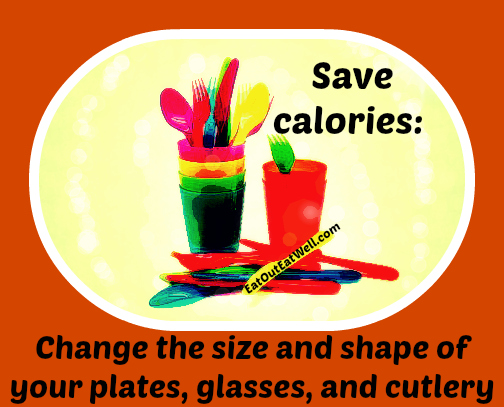
5 Ways Your Plates, Glasses, Forks And Spoons Can Save You Calories

September 9, 2013 By Penny Klatell, PhD, RN Leave a Comment

Colored glasses and cutlery on white background

  1. If you’re full, stop eating and clear your plate right away.  If it hangs around in front of you, you’ll keep picking at it until there’s nothing left. An exception – a study has found that looking at the “carnage” – the leftover bones on your plate from barbecued ribs or even the number of empty beer bottles in front of you – can serve as an “environmental cue” to stop eating.
  2. Drink from a tall, thin glass instead of a short, wide one. You’ll drink 25%-30% less. People who were given short wide glasses poured 76% more into them than people who were given tall slender glasses — and they believed that they had poured less!  Even experienced bartenders poured more into a short, wide glass than they did into a taller, thinner one.
  3. 3.   Use a (smaller) fork and knife instead of your fingers, a teaspoon rather that a tablespoon. It takes longer, requires more effort, and provides a smaller “shovel” for getting food into your mouth. Chopsticks slow you down even more. Chew your food instead of wolfing it down.  If you have to work at eating your food – cutting with a knife for instance – you’ll eat more mindfully than if you pick food up with your fingers and pop it into your mouth.
  4. Use a smaller plate. We eat an average of 92% of what we serve ourselves. We pile more food onto larger plates, so a larger plate means we eat more food. A two inch difference in plate diameter—decreasing the plate size to ten inches from 12 inches—would mean a serving that has 22% fewer calories. It’s a smaller serving but not small enough to leave you still hungry and heading back for seconds.
  5. Get those serving dishes off of the table. If most of your meals are family style with bowls and platters of food brought to the table for everyone to help themselves, keep the serving dishes off of the table and onto the counter if you want to save some calories.  When serving dishes are left on the table men eat 29% more and women 10% more than when serving dishes stay on the counter. It’s harder to mindlessly shove food into your mouth if you have to get up to get it. Sticking out your fork and shoveling more onto your plate while your butt remains firmly planted in your chair makes it far too easy to munch without much thought about the quantity of food that’s going into your mouth.

Want more tips — especially if you eat in dining halls of any kind?  Get my new book, now available on Amazon — 30 Ways to Survive Dining Hall and Dorm Room Food: Tips to Avoid the Freshman 15.

Filed Under: Calorie Tips, Healthy Eating, Food Facts, Eating with Family and Friends, Entertaining, Buffets, Parties, Events, Food for Fun and Thought, Manage Your Weight, Shopping, Cooking, Baking, Snacking, Noshing, Tasting Tagged With: calories, cutlery, glass size, manage your weight, plate size, save calories

7 Football Food Tips To Keep You Happy, Not Stuffed

September 5, 2013 By Penny Klatell, PhD, RN Leave a Comment

tailgating grillFootball season is here. It means fun and excitement along with angst, wringing of the hands, a whole new spin on vocabulary, and tons of food and drinks.

It seems as though football has nine main food groups: beer, wings, pizza, chips and dip, barbecued ribs, burgers, chili, sausage (especially bratwurst), and pulled pork. It’s a calorie bonanza.

In a national survey, fans were asked if game day calories count.  46% said their diet goes out the window when they’re tailgating or watching their team play and 39% said calories count but they still indulge in a few favorites on game day.

10 Tips To Keep You Happy . . .

or at least your stomach and waistline happy.  In this instance, your favorite football team is responsible for your mental happiness (or anguish).

1. Be aware of what and how much you’re eating. Mindless munching is a calorie disaster.  You’re shoving hundreds of calories into your mouth and it’s probably not even registering that you’re eating.  Put a portion on a plate and eat it instead of the constant hand to mouth action off of a platter or open bowl. It’ll save you hundreds of calories.

2. Learn approximately how many calories are in a portion of your favorite football food so you can make intelligent choices.  That way you’re not denying yourself what you love, but if pulled pork has hundreds more calories than a grilled sausage and you love them both, would you choose one over the other?

3.  Save your calories for what you love and pass on the other stuff.  You don’t have to eat it just because it’s there and it’s traditional football food.  If you really don’t love guacamole why would you eat it?  Salsa has a lot fewer calories.

4.  Don’t be starving at game time (or for the pregame tailgate).  Have a healthy protein based snack (about 150 calories) before the game. Just don’t have a snack and then eat the same amount out of habit – then you’re just adding the snack calories to all of the others.

5.  Cut it down a little.  Can you have 4 or 5 wings instead of 6 or 7?  How about a slider instead of a burger, 2 pieces of pizza instead of 3, or ½ a grinder instead of a whole one?  Put only 1 or 2 toppings on your chili instead of sour cream, cheese, guacamole, and a never-ending supply of chips or nachos.

6. If you’re doing some shopping or cooking (or bringing food) for a tailgate or party, try making a slightly healthier version of your favorite food.

  • Fried chicken: Use crushed cornflakes for the breading and bake instead of frying
  • Nachos: Use low-fat cheese and salsa
  • Creamy dips: Use 2% yogurt instead of sour cream
  • Chips: Buy baked, not fried
  • Chili: Go beans only or use extra-lean ground beef or extra-lean ground turkey instead of ground chuck
  • Pizza:  Order thin crust instead of deep dish and stick with veggie toppings or plain cheese instead of pepperoni or meatball toppings

7.  Beer.  There can be a huge variation in calories between brands and types of beer.

On average:

  • 12 ounces of beer has 153 calories and 13.9 grams of alcohol
  • 12 ounces of lite beer has 103 calories and 11 grams of alcohol

Different types of beer and malt liquor can have very different amounts of alcohol content. Light beers can almost as much alcohol as regular beer – about 85% as much.   Put another way, on average:

  • Regular beer: 5% alcohol
  • Some light beers: 4.2% alcohol
  • Malt liquor:  7% alcohol

For an extensive list of the calories in many popular brands of beer, click HERE.

Want more tips — especially if you eat in dining halls of any kind?  Get my new book, now available on Amazon — 30 Ways to Survive Dining Hall and Dorm Room Food: Tips to Avoid the Freshman 15.
Filed Under: Calorie Tips, Healthy Eating, Food Facts, Eating with Family and Friends, Entertaining, Buffets, Parties, Events, Manage Your Weight, Shopping, Cooking, Baking, Snacking, Noshing, Tasting, Takeout, Prepared Food, Junk Food Tagged With: football food, football party food, Freshman 15, tailgate food, tailgating

5 Quick And Easy Calorie Saving Tips

September 3, 2013 By Penny Klatell, PhD, RN 1 Comment

Single chocolate chip cookie with a single bite

  1. A chocolate chip cookie—or oatmeal raisin for that matter—should be about the size of the rim of a soda can. Some cookies are four times that size—and with four times the calories and fat content!
  2. Don’t be duped by turkey, fish, and veggie burgers and sandwiches. They sound healthier and less caloric than beef, but that might not be the case. At Red Robin a grilled turkey burger has 578 calories, 29g fat. Burger King’s Premium Alaskan Fish sandwich has 530 calories, 28g fat while a Whopper Jr. without mayo has 260 calories, 10g fat. A Sedona Black Bean Burger at TGI Fridays has 870 calories, 49g fat.
  3. Bottled water isn’t always just water. Some are just water or water with flavor essence but lots of them are naturally or artificially sweetened, flavored, and colored. Don’t be duped. For instance, many Vitaminwater flavors have 50 calories in a serving (8 ounces), but the bottles are usually 20 ounces which makes the contents around 120 calories and 30+ grams of sugar. There are no-calorie Vitaminwater Zeros, too.
  4. Skip the bran muffin for breakfast. We think bran muffins are “healthy” because they have the word bran in their name, but they’re actually made with a lot of sugar and fat. A Dunkin’ Donuts Honey Bran Raisin Muffin has 480 calories with 15 grams of fat and 79 grams of carbs (it does, however, have 5 grams of fiber). In general, a 4 ounce bran muffin has around 350 calories—but, have you seen the size of most muffins—they sure don’t tip the scales at 4 ounces.
  5. Cans and boxes that look like single servings may have two or three. They may look small enough to be for one, but that doesn’t mean it’s true. Check out how many servings are in your can of soup or box of mac and cheese.

Want more tips — especially if you eat in dining halls of any kind?  Get my new book, now available on Amazon — 30 Ways to Survive Dining Hall and Dorm Room Food: Tips to Avoid the Freshman 15.

Filed Under: Calorie Tips, Healthy Eating, Food Facts, Eating on the Job, Food for Fun and Thought, Manage Your Weight, Snacking, Noshing, Tasting, Takeout, Prepared Food, Junk Food Tagged With: calorie saving tips, dining hall tips, dorm room food, Freshman 15, weight management

3 Easy Barbecue and Picnic Tips To Avoid Overeating

August 30, 2013 By Penny Klatell, PhD, RN Leave a Comment

picnic-table-overeating-graphic1.  If you’re full, stop eating and clear your plate right away.  If it hangs around in front of you, you’ll keep picking at it until there’s nothing left. An exception – a study has found that looking at the “carnage” – the leftover bones from barbecued ribs or even the number of empty beer bottles – can serve as an “environmental cue” to stop eating.

2.  Do you really need to stand in front of the picnic table, kitchen table, or barbecue?  The further away from the food you are the less likely you are to eat it. Don’t sit or stand where you can see the food that’s calling your name. Keep your back to it if you can’t keep distant. There’s just so much control you can exercise before “see it = eat it.”  If staying near the food gets to be too much, go for a walk, a swim, or engage someone in an animated conversation. It’s pretty hard to shove food in your mouth when you’re busy talking.

3.  Before you grab some tasty ribs, dogs, burgers or pie — ask yourself if you really want it.  Are you hungry?  Is it worth the calories?  Odds are, the tempting display of food in front of you is visually seductive – and may smell great, too — but you’re reaching out to eat what’s in front of you for reasons not dictated by your stomach but by your eyes. Have you decided that you want to splurge on something specific? Try picking it ahead of time and commit to your choice so you don’t find yourself wavering in the face of temptation.

Filed Under: Calorie Tips, Healthy Eating, Food Facts, Eating with Family and Friends, Entertaining, Buffets, Parties, Events, Manage Your Weight, Travel, On Vacation, In the Car Tagged With: barbecue food, eat out eat well, eating strategies, overeating, overeating triggers, picnic food

  • « Go to Previous Page
  • Go to page 1
  • Interim pages omitted …
  • Go to page 25
  • Go to page 26
  • Go to page 27
  • Go to page 28
  • Go to page 29
  • Interim pages omitted …
  • Go to page 87
  • Go to Next Page »

Primary Sidebar

Recent Posts

  • Buy Me Some Peanuts And Cracker Jacks
  • Is Your Coffee Or Tea Giving You A Pot Belly?
  • PEEPS: Do You Love Them or Hate Them?
  • JellyBeans!!!
  • Why Is Irish Soda Bread Called Soda Bread or Farl or Spotted Dog?

Topics

  • Calorie Tips, Healthy Eating, Food Facts
  • Eating on the Job
  • Eating with Family and Friends
  • Entertaining, Buffets, Parties, Events
  • Food for Fun and Thought
  • Holidays
  • Lose 5 Pounds in 5 Weeks
  • Manage Your Weight
  • Restaurants, Diners, Fast Food
  • Shopping, Cooking, Baking
  • Snacking, Noshing, Tasting
  • Takeout, Prepared Food, Junk Food
  • Travel, On Vacation, In the Car
  • Uncategorized

My posts may contain affiliate links. If you buy something through one of the links you won’t pay a penny more but I’ll receive a small commission, which will help me buy more products to test and then write about. I do not get compensated for reviews. Click here for more info.

The material on this site is not to be construed as professional health care advice and is intended to be used for informational purposes only.
Copyright © 2025 · Eat Out Eat Well®️. All Rights Reserved.