• Skip to secondary menu
  • Skip to main content
  • Skip to primary sidebar

Eat Out Eat Well

  • Home
  • About
  • Eats and More® Store
  • Books
  • Contact

Eating with Family and Friends

Are You Ready For Holiday Eating?

November 19, 2013 By Penny Klatell, PhD, RN Leave a Comment

holiday-eating-fork-knife-spoonHoliday cookies, latkes, pumpkin pie, cornbread stuffing, eggnog, and a relative’s specialty of the season … food, food, food!

‘Tis the season to eat and there are “food landmines” everywhere you turn. We all have to eat but it can be a very slippery slope to eat well surrounded by food; family; friends; an encyclopedia of cultural, religious, and family traditions; and a whole host of expectations.

Holidays are supposed to be days of celebration and special significance — often religious, cultural, or traditional. Sometimes, they’re days just meant for play. A common denominator is that we often incorporate food – and lots of it — into celebrations.

Realistically, the actual content of your Thanksgiving, Hanukkah, Christmas, or other holiday meal matters very little in the grand scheme of things. Although a few hundred calories here or there can make a difference when added up over weeks and years, the impact of overeating at one meal is usually negligible – even though your stomach might be singing a different song.

It’s the inevitable mindless eating – those treats on the receptionist’s desk, the gift of peanut brittle, the holiday toasts, the second and third helpings, the holiday cookies in the snack room – that are the main source of excess calories and added pounds during the holiday season.

What To Do

  •  See it = eat it. It‘s incredibly difficult not to nibble your way through the day when you have delicious treats tempting you at every turn. How many times do your senses need to be assaulted by the sight of sparkly cookies and the holiday scent of eggnog or spiced roasted nuts before your hand reaches out and the treat is popped into your mouth?
  • Don’t keep your trigger foods stocked in your pantry or fridge.  If you need to have supplies, don’t make them immediately visible.  Hide them in the back of the cabinet or in a “not too easy to be reached” location.
  •  Be aware of openly displayed platters and bowls of cookies, nuts, candy, and other holiday specialties.  Make up your mind that it’s not okay – just because it’s the holidays – to taste test everything that crosses your path.

Coming soon to the Apple newsstand for your ipad and iphone:  Eat Out Eat Well Magazine!

Filed Under: Calorie Tips, Healthy Eating, Food Facts, Eating with Family and Friends, Holidays, Manage Your Weight, Shopping, Cooking, Baking, Snacking, Noshing, Tasting Tagged With: eating behavior, holiday eating, holiday food, holidays, mindles eating

How Much Halloween Candy Will You Swipe From Kids’ Trick or Treat Bags?

October 28, 2013 By Penny Klatell, PhD, RN Leave a Comment

Trickor Treat jack o' lanterns

Come on, ‘fess up. What do you do?  Do you just randomly grab candy out of trick or treat bags – or are you more selective?  If your kids go trick or treating, when they get home do you dump everything in the bag on the table and go through it to hunt down your favorites?

Like it or not – candy rules on Halloween. Adults may dread the easy accessibility of candy – it’s everywhere – but secretly, a whole lot of us can’t wait to get our hands on our favorite kid candy.

Americans buy nearly 600 million pounds of candy for Halloween. On average, we eat 24 pounds of candy a year, probably a whole lot of it right around this time. The most popular types of candy, in order, are:  chocolate, chewy candies, and hard candy.

What Do You Go For First?

Trick or Treat Bags – plastic pumpkins and colorful bags loaded with a collection of sweet memories and some dental nightmares.

If you’ve ever swiped candy from your kid’s trick or treat bag, don’t feel guilty. According to the National Confectioners Association you’re certainly not alone. Ninety percent of parents confess they occasionally dip into their kid’s stash.

And they do it big time! Parents eat one candy bar out of every two a child brings home.  Favorite targets are snack-sized chocolate bars (70%), candy-coated chocolate pieces (40%), caramels (37%) and gum (26%).

How Many Calories Are In That Rick Or Treat Bag — Or Pumpkin?

It’s been estimated that, on average, a child in the US collects between 3,500 and 7,000 worth of candy calories on Halloween night.

Mathematically, it takes around 3,500 calories to gain or lose a pound, so you’re looking at around a pound or two if you would choose to eat all of those mostly sugar and fat candy calories on top of your regular meals.

It’s Just One Night …

One evening of collecting (and eating) candy certainly isn’t going to make anyone overweight or obese.  But a constant bombardment of candy, sweets, and other treats can certainly lead to weight and health challenges.

Try this.  Have a talk with your family – or with yourself — ahead of Trick of Treating to plan on what to do the candy collection.  Is it to be a one-day free for all and then the trash — or will the candy by doled out in measured amounts over a given period of time?  Do what works for your family but it helps if the kids buy into the plan.

What’s amazing is that when kids are offered the option of choosing how much and what kind of candy to eat, most of them don’t go overboard – they make their selections, eat it, and that’s it. It then helps if the candy fades from sight.  It can be doled out in smaller portions day by day – or it can magically diminish in quantity or disappear entirely – just not down the hatch of an all-too-willing adult.

Filed Under: Calorie Tips, Healthy Eating, Food Facts, Eating with Family and Friends, Food for Fun and Thought, Holidays, Snacking, Noshing, Tasting, Takeout, Prepared Food, Junk Food Tagged With: candy, Halloween, Halloween candy, holidays, trick or treat, trick or treat bags

How Full Is Your Wine Glass? 3 Things Can Make You Pour Up To 12% More

October 7, 2013 By Penny Klatell, PhD, RN Leave a Comment

wine bottle and wineglass graphicDo you know how many ounces of wine you pour into your wine glass?  Bet you don’t!

A standard serving of wine is 5 ounces (around 125 calories) and probably looks smaller than you think. Wine glasses generally have a much larger capacity — good for savoring the wine, but not good for  pouring portion controlled amounts.

Even though we might think we’re in control of how much we’re pouring, visual cues definitely affect how much ends up in the glass.

3 Things That Make A Difference

A new study published in Substance Use and Misuse found that people poured 11.9% more wine into a wide glass than a narrow one. They also poured 12.2% more wine into a glass when the glass was held their hands rather than when they poured into a glass sitting on a table or counter.

Color contrast made a difference, too. People poured 9.2% more white wine into a clear glass than they did red. High contrast between the wine and the glass — for instance red wine in a clear glass — makes it easier to see the level of the wine.

Tip

If you want to be careful about how much wine you’re drinking, go for taller thinner glasses rather that shorter big-bowled ones; stick to red wine – or wine that has color contrast with your glass; and when you pour, put the glass on the table rather that holding it in your hand.

Filed Under: Calorie Tips, Healthy Eating, Food Facts, Eating with Family and Friends, Entertaining, Buffets, Parties, Events, Manage Your Weight Tagged With: calories in wine, portion of wine, pouring drinks, wine, wine serving, wineglass

Want To Eat Fast? Choose Restaurants With Red and Gold Décor And Loud Music

October 2, 2013 By Penny Klatell, PhD, RN Leave a Comment

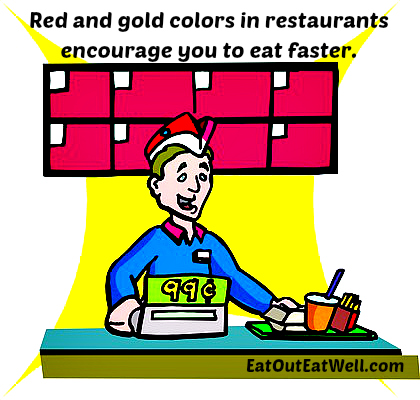
fast food counter graphic

What are the main colors used in McDonald’s, Burger King, KFC, and most fast food restaurants – diners, included? Answer:  Red and gold.

Restaurant Décor Is Planned For A Reason You Might Not Guess

Restaurant decor isn’t an accident, especially in chain restaurants keyed into behavioral and eating psychology.  Restaurants are designed with the intention of getting you to eat and run or to keep you at the table longer so you order more.

Speed Eating

Fast food and high turnover restaurants are decorated for speed eating.  No soothing pastels, sound absorbing surfaces, or soft music to be seen or heard. Instead you’ll find loud music, noise reflecting off of hard surfaces, and high arousal color schemes — frequently red and gold.

It takes about 20 minutes for your stomach to communicate to your brain that you’re full. A red, gold, and noisy environment makes you gulp your food and reach for more way before 20 minutes have come and gone. Or, it helps convince you to gulp down your food and make your exit pretty quickly. The rapid table turnovers allow the restaurant to pack more people in – and then serve more food – quickly!

Leisurely Dining

On the other hand, people tend to linger at restaurants with low lighting, soft music, flowers, and tablecloths.  The white tablecloths and soft music of “fancy” restaurants make it pleasant to linger longer — and order another glass of wine, dessert, coffee, or after dinner drink. The attentive waitstaff obligingly offers you more and more options — and you’re likely to agree. In this type of eating environment you end up ordering and eating more than you had planned.

Know your setting:  pace yourself in the speed environment and avoid the temptation to keep ordering in the relaxed environment.

Filed Under: Eating with Family and Friends, Restaurants, Diners, Fast Food, Takeout, Prepared Food, Junk Food, Travel, On Vacation, In the Car Tagged With: eating quickly, eating slowly, fast eating, fast food, fast food restaurants, leisurely dining, loud restaurants, restaurant colors, speed eating

Does Alcohol Make You Gain Weight?

September 19, 2013 By Penny Klatell, PhD, RN Leave a Comment

alcohol-and-weight-gain-graphic

It certainly can. Pure alcohol, gram for gram, has almost twice the number of calories as a gram of carbohydrate or protein. One gram of alcohol has 7 calories compared to the 4 calories for carbohydrate or protein – fat has nine calories a gram. Some research is showing that calories from alcohol may be burned less efficiently, but the calories still pack a punch.

There’s another factor, too.  If you drink alcohol along with your other daily food, you’re often adding, not replacing, the calories from other food or drinks. If everything else stays the same, you’ll gain weight. And, alcohol can cause disinhibition — it reduces your ability manage your immediate impulsive response to a situation – in other words, it makes you less focused on how much you’re eating.

However, statistically, drinkers aren’t more likely to be obese than nondrinkers. But a number if factors come into play: the amount and type of alcohol; when, where, and the type of drinking pattern; the way your body processes the alcohol; and various psychological factors.

Gender Differences On Drinking Days

A study in the American Journal of Clinical Nutrition compared the food and calorie intake of 1,864 people on days when they did and didn’t drink. On drinking days men (including 10% who were heavy drinkers which would skew the numbers higher) averaged 433 extra calories; 363 of them came from alcohol, the rest from extra food and other kinds of beverages. The men also ate more protein, fat, salt, and meat on drinking days.

Women averaged an extra 299 calories on drinking days, almost all of them coming from alcohol. Although they didn’t eat much more than on nondrinking days, they did eat more fat and less healthy foods.

Good News, Bad News

About 35% of American adults don’t drink, 55% are light or moderate drinkers, and 10% drink more than a moderate amount. It’s estimated that alcohol directly or indirectly causes 90,000 deaths a year in the US, including more than 11,000 traffic fatalities.

But drinking has benefits, too It can be part of social, business and family life and regular drinking, even in small amounts, decreases the risk of cardiovascular disease. Alcohol, like aspirin, reduces blood clotting — a transient effect that lasts for about a day. Alcohol can raise HDL (“good”) cholesterol levels over time and moderate intake helps to reduce the risk of other health problems, including type 2 diabetes, gallstones, peripheral artery disease, and perhaps dementia.

The most serious health risks — alcoholism, heart and liver disease, hypertension, certain cancers, osteoporosis, car crashes and other accidents — come mostly from heavy drinking, but moderate drinking can affect your coordination and ability to drive, operate machinery, or swim.

If You’re Going To Drink, Should You Do It Every Day?

It seems that drinking small amounts regularly and with meals  (it slows the absorption of the alcohol) is better than occasionally drinking larger amounts. Some research findings suggest that daily (or almost daily) drinking is best for the heart; other studies have found that drinking every other day is enough to get benefits; and still others have found that it only takes half a standard drink a day. (In the US a “drink” is 5 ounces of wine, 12 ounces of beer, or 1.5 ounces of 80-proof liquor, which all contain about 14 grams of pure alcohol.)

What’s Moderate Drinking?

In the US, moderate drinking — as defined in the Dietary Guidelines for Americans — is up to one drink a day for a woman and up to two for a man. (Other countries define moderation and the size of a “standard” drink differently.) The recommended amount is less for women because they tend to be smaller, have proportionately more body fat, and have less body water (alcohol is diluted in body water). Generally, the same amount of alcohol would cause higher blood level of alcohol in women than in men and would also cause more impairment.

Filed Under: Calorie Tips, Healthy Eating, Food Facts, Eating with Family and Friends, Food for Fun and Thought, Manage Your Weight, Restaurants, Diners, Fast Food, Snacking, Noshing, Tasting, Travel, On Vacation, In the Car Tagged With: alcohol and weight gain, calories, calories in alcohol, disinhibition, Freshman 15, moderate drinking

  • « Go to Previous Page
  • Go to page 1
  • Interim pages omitted …
  • Go to page 9
  • Go to page 10
  • Go to page 11
  • Go to page 12
  • Go to page 13
  • Interim pages omitted …
  • Go to page 27
  • Go to Next Page »

Primary Sidebar

Recent Posts

  • Buy Me Some Peanuts And Cracker Jacks
  • Is Your Coffee Or Tea Giving You A Pot Belly?
  • PEEPS: Do You Love Them or Hate Them?
  • JellyBeans!!!
  • Why Is Irish Soda Bread Called Soda Bread or Farl or Spotted Dog?

Topics

  • Calorie Tips, Healthy Eating, Food Facts
  • Eating on the Job
  • Eating with Family and Friends
  • Entertaining, Buffets, Parties, Events
  • Food for Fun and Thought
  • Holidays
  • Lose 5 Pounds in 5 Weeks
  • Manage Your Weight
  • Restaurants, Diners, Fast Food
  • Shopping, Cooking, Baking
  • Snacking, Noshing, Tasting
  • Takeout, Prepared Food, Junk Food
  • Travel, On Vacation, In the Car
  • Uncategorized

My posts may contain affiliate links. If you buy something through one of the links you won’t pay a penny more but I’ll receive a small commission, which will help me buy more products to test and then write about. I do not get compensated for reviews. Click here for more info.

The material on this site is not to be construed as professional health care advice and is intended to be used for informational purposes only.
Copyright © 2024 · Eat Out Eat Well®️. All Rights Reserved.