• Skip to secondary menu
  • Skip to main content
  • Skip to primary sidebar

Eat Out Eat Well

  • Home
  • About
  • Eats and More® Store
  • Books
  • Contact

Eating with Family and Friends

How Many Calories Are In Your Favorite Summer Drinks?

August 6, 2015 By Penny Klatell, PhD, RN Leave a Comment

Favorite-summer-drink

It’s hot.  You’re thirsty.  You want something cool – or maybe ice cold – to drink.

Check Out The Calories

A lot of cool, refreshing drinks come with a hefty dose of calories. You might be surprised how many are in a drink you’ve been having for years.

According to CSPI (Center for Science in the Public Interest), carbonated soft drinks are the single biggest source of calories in the American diet.  It’s easy to forget about the calories in sugared sports drinks, sweetened ice teas, juices, and alcoholic beverages.

Alcohol isn’t a caloric bargain – it has 7 calories per gram (protein and carbs have 4 calories per gram and fat has 9 calories per gram). Add sweetened juices, syrups, or soda to your alcohol, and you could be drinking a significant portion of your suggested daily calorie allowance.

It helps to do some research to figure out what’s your best choice to grab from the deli, the food truck, the coffee shop, or at the bar.

Can you be satisfied with a bottle of beer that has around 100 calories rather than another brand that has around 300 – or water with a hint of flavor instead of a sports drink?

To help you with your choices, here are the calories in some summer favorites:

Water and Sports Drinks

  • Gatorade, 12 ounces: 80 calories
  • Gatorade G Orange, 12 ounce bottle:  80 calories
  • Gatorade G2 Perform Low Calorie Orange, 8 ounces: 20 calories
  • SoBe Lifewater, 20 ounces: 90 calories
  • Sobe Lifewater 0 calories Black & Blue Berry, 8 ounces: 0 calories
  • Glaceau Smart Water, 33.8 ounces: 0 calories
  • Vitamin Water, 20 ounces: 125 calories
  • Vitamin Water 10, 20 ounces: 25 calories
  • Perrier Citron Lemon Lime, 22 ounce bottle:  0 calories
  • Vitamin Water Focus Kiwi-Strawberry, 20 ounce bottle:  125 calories
  • Hint Blackberry, 16 ounce bottle:  0 calories
  • Powerade, Grape, 8 ounces: 50 calories
  • Propel Kiwi-Strawberry, 8 ounces: 10 calories
  • Water (as much as you want):  0 calories

Iced Coffee and Tea Drinks

  • Dunkin’ Donuts Vanilla Bean Coolatta, 16 ounces: 430 calories
  • Dunkin’ Donuts Sweet Tea, 16 ounces: 120 calories
  • Starbuck’s Coffee Frappuccino, 16 ounces (grande): 240 calories
  • Starbuck’s Coffee Frappuccino light, 16 ounces grande: 110 calories
  • Tazo Unsweetened Shaken Iced Passion Tea:  0 calories
  • Iced Brewed Coffee with classic syrup, 12 ounces (tall): 60 calories
  • Red Bull Energy Drink, 8.4 ounces, 110 calories

Soda and Non-Carbonated Drinks

  • Mountain Dew, 20 ounce bottle: 290 calories
  • Coke Classic, 20 ounce bottle: 233 calories
  • Diet coke, 20 ounce bottle: 0 calories
  • Snapple Orangeade, 16 ounces:  200 calories
  • San Pelligrino Limonata, 11.15 ounce can:  141 calories
  • Can of Coke, 12 ounces:  140 calories
  • Bottle of 7Up, 12 ounces:  150 calories
  • Root beer float, large, 32 ounces:  640 calories

Beer (12 ounce bottle)

  • Sierra Nevada Bigfoot Ale: 330 calories
  • Samuel Adams Boston Lager: 180 calories
  • Guinness Extra Stout: 176 calories
  • Pete’s Wicked Ale: 174 calories
  • Harpoon IPA: 170 calories
  • Heineken: 166 calories
  • Killian’s Irish Red: 163 calories
  • Long Trail: 163 calories
  • Molson Ice: 160 calories
  • Samuel Adams Brown Ale:  160 calories
  • Budweiser:  144 calories
  • Corona Light: 105 calories
  • Coors Light: 102 calories
  • Heineken Light: 99 calories
  • Budweiser Select: 99 calories
  • Miller Light: 96 calories
  • Amstel Light: 95 calories
  • Anheuser Busch Natural Light: 95 calories
  • Michelob Ultra: 95 calories
  • Miller MGD 64:  64 calories
  • Beck’s Premier Light: 64 calories

Wine

  • Red Wine, 5 ounces: 129 calories
  • White Wine, 5 ounces: 120 calories
  • Sangria, 8 ounces: 176 calories

Alcoholic Drinks

  • Mojito, 7 ounces: 172 calories
  • Frozen Magarita, 4 ounces: 180 calories (the average margarita glass holds 12 ounces, 540 calories)
  • Mimosa:  137 calories
  • Gin and Tonic:  175 calories

Filed Under: Eating with Family and Friends, Entertaining, Buffets, Parties, Events, Restaurants, Diners, Fast Food, Snacking, Noshing, Tasting, Travel, On Vacation, In the Car Tagged With: calories in beer, calories in summer drinks

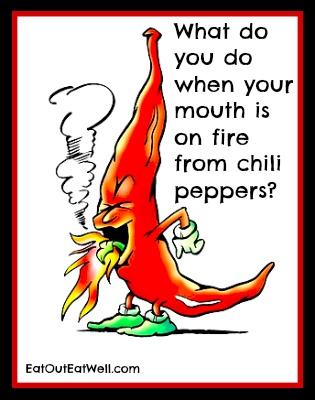
What To Do When Your Mouth Is On Fire From Red Hot Chili Peppers

May 5, 2015 By Penny Klatell, PhD, RN Leave a Comment

red hot chili pepper breathing fire

I was in a restaurant that specializes in chili – hot, hotter, and hottest.  Four large thirty-something guys were sitting at the table next to mine. One guy ordered, “hottest,” with an “I can handle it, no problem” look on his face.

Shortly after this big, burly guy dug into his chili he was sitting glassy eyed, rivulets of sweat dripping off of his bald head, practically unable to speak.  The waitress, obviously having seen this happen before, came running over with a glass of milk with orders to “drink up.”

Have you ever had a similar reaction to very spicy food — maybe even from something from your own kitchen when you got a little too heavy-handed with the chili powder? Or perhaps, like this guy, from being a little too macho and ordering “hottest” – despite warnings from the waitstaff.

What Causes The Burn?

Capsaicin is mostly responsible for the “heat” in chili peppers.  The amount in different kinds peppers varies widely. Environmental factors and the maturity of the pepper also affect the “burn” factor.

Chiles grown in hot dry climates tend to be a little hotter and the capsaicin content in a pepper is the highest when peppers reach full maturity. Habanero peppers are always extremely hot because of their high capsaicin content but ancho and paprika chili peppers can be as mild as a bell pepper.

How To Tame The Flame

What do you do when your mouth is sending a five-alarm signal, your face is on fire, and you’re sweating enough to water every plant in the room?

To stop the flames in your mouth you need to neutralize the burning heat from the capsaicin that binds to your taste buds. Remember that you want to neutralize the capsaicin, not just make your mouth feel better — although that’s also an objective.

Solutions

  • The most common flame relievers are full fat dairy, acid, and sugar – although some people also swear by nut and seed butters (peanut, almond, tahini). They may all have some degree of effectiveness.
  • Ice and water will feel pretty good, but they’re only a temporary feel-good fix. The burning pain will come roaring back. Capsaicin is soluble in both alcohol and fat so full fat dairy and alcohol are possible solutions.
  • Neutralizing the capsaicin will be the most effective.  How do you do that? The most common things to counteract the heat of chilies are full fat dairy, acids, and sugar. Some people also swear by nut and seed butters (peanut, almond, tahini). They may all have some degree of effectiveness.
  • Capsaicin is soluble in alcohol and fat, and sometimes beer is suggested as a solution because the alcohol will help to neutralize the capsaicin molecules.  Since beer is about 95% water it won’t really neutralize the capsaicin clinging to your tongue. The harder stuff might help but you’d have to drink a lot of it and you’d end up feeling no pain for other reasons.
  • Acid can cut through the heat so try vinegar, lemon or lime juice, or anything acidic that doesn’t mess with the taste of your food. Now you know why you often see lemon or lime wedges served with spicier food.  Gives beer with lime new meaning, doesn’t it?
  • High fat dairy products like milk, cheese, sour cream, yogurt, and ice cream will coat your mouth and can break the bonds capsaicin forms with the nerve endings – and, since they’re cold, they feel pretty good, too. There’s a reason that spicy Mexican food is often served with sour cream and cheese!
  • Sugars bind to pain receptors more readily than capsaicin so sweet things might work, too.   Sugar, fruit, honey, molasses, even carrots have all been used.  Highly sweetened non-carbonated drinks may work.  Try some sweet tea.   Hoisin may work for Asian dishes or Lassi (sweet and dairy combination) if you’re in an Indian restaurant. Have some fruit for dessert – it’s cold and sweet and the more acidic fruit, like citrus and pineapple, add another layer of potential pain relief.

Filed Under: Calorie Tips, Healthy Eating, Food Facts, Eating with Family and Friends, Entertaining, Buffets, Parties, Events, Shopping, Cooking, Baking, Snacking, Noshing, Tasting Tagged With: capsaicin, chili peppers, hot and spicy food, spicy food

Stadium Food: What Do You Eat?

April 15, 2015 By Penny Klatell, PhD, RN Leave a Comment

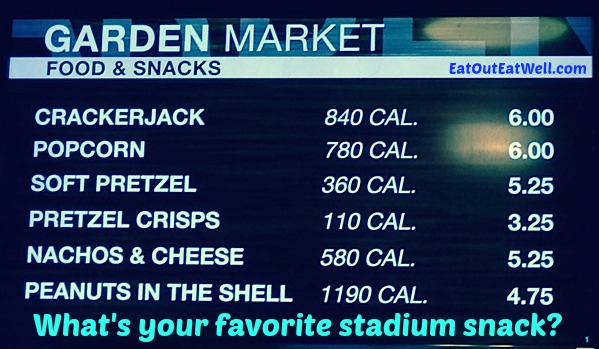
MSGSnacksGraphicSnacks at Madison Square Garden

It is the beginning of baseball season, but more importantly – at least in my family – it’s the beginning of hockey playoffs. To call us True Blue New York Rangers fans might be an understatement.

So what do you eat when you go to a game? Many stadiums now offer “gourmet” and “specialty” food – at Madison Square Garden you can buy both sushi and gluten free sandwiches – but from my observation, most fans at sporting events still opt for burgers and dogs, popcorn and peanuts, soda and beer. Every year, especially at ballparks, there seem to be some new “upscale” additions, but from those I’ve heard advertised this year, the size, calories, and price are almost guaranteed to make your clothing a bit more snug and your wallet a bit lighter.

So what do you choose when there are food vendors about every 20 feet hawking dogs, hot pretzels, fried everything, and mega-sized desserts?

Classic Stadium Food – Make Good Choices

If you’ve got a will of iron you could ignore the food and drinks.  But, if you don’t — or don’t want to — you can try to minimize the caloric damage without taking away the fun.  If you know you’re going to be having a stadium meal, do some thinking and planning.  The best choices aren’t always the obvious ones.

Must you have both peanuts and popcorn?  Can you make do with a regular hot dog instead of a foot-long?  Can you keep it to one or two beers instead of three?  Can you choose the small popcorn instead of the jumbo tub? Can you ditch the soda — or maybe the second one — and replace it with water?

It’s all about choices. Here’s some info about 10 foods that most likely will call your name at one time or another:

Hamburger:   A plain 6-ounce burger made of food stand beef (they’re not using extra lean – the more fat, the juicier it is) on a bun has about 490 calories. Cheese and other toppings can significantly up the ante.

6-ounce grilled chicken sandwich: 280 calories – not a bad choice.  6 ounces of chicken tenders clock in at 446 calories.  Barbecue dipping sauce adds 30 calories a tablespoon.

Hot Dogs: Most sold-out baseball stadiums can sell 16,000 hot dogs a day. A regular hot dog with mustard has about 290 calories — that’s 180 for the 2-ounce dog, 110 for the bun, zilch for regular yellow mustard. Two tablespoons of sauerkraut adds another 5-10 calories and a punch of flavor, 2 tablespoons of ketchup adds 30, and 2 tablespoons of relish another 40. A Nathan’s hot dog racks up 320 calories; a foot-long Hebrew National 510 calories.

Pizza: Stadium pizza is generally larger than a usual slice, about 1/6 of a 16-inch pie (instead of 1/8) making it about 435 calories a slice – don’t forget that toppings add calories.

French Fries and Nachos: A large serving of French fries has about 500 calories. A serving of Hardee’s chili cheese fries has 700 calories and 350 of them come from fat. A 12-ounce serving of super nachos with cheese: (40 chips, 4 ounces of cheese) has about 1,500 calories! Plain French fries look like a caloric bargain by comparison.

Cracker Jack (officially cracker jack, not jacks): candy coated popcorn with some peanuts. A 3.5-ounce stadium size box has 420 calories but also has 7g of protein and 3.5g of fiber.             

Cotton Candy: nothing but heated and artificially colored sugar that’s spun into threads with added air. Cotton candy on a stick or wrapped around a paper cone (about an ounce) has around 105 calories; a 2-ounce bag (common size) has 210. A lot of sugar, but not a lot of calories – albeit empty ones.

Peanuts in the Shell: What would a baseball game be without a bag of peanuts? Stadiums can sell as many as 6,000 bags on game days. An 8-ounce bag has 840 calories; a 12-ounce bag has 1,260. Yes, they have some protein and fiber.  But wow on the calories.

Soft Pretzel: One large soft pretzel has 483 calories – giant soft pretzels (7-8 ounces) have about 700 calories.

Ice Cream: Your team’s mini-helmet filled with swirly Carvel, 550-590 calories. A Good Humor Chocolate Éclair has 160 calories, 8g fat, 11g sugar; a Fudgsicle Fudge Bar has 100 calories, 2.5g fat, 13g sugars; a Klondike sandwich, 81g has 250 calories, 17g fat, 18g sugars.

Popcorn: At Yankee Stadium a jumbo-sized souvenir bag has 1,484 calories and a souvenir bucket has 2,473 calories. On average, a 3-ounce bag of all brands (plain/ready-to-eat) has 480 calories and 24g fat.

Candy:

  • Junior Mints, 3-ounce box:  360 calories, 7g fat
  • Sno Caps, 3.1-ounce box:  300 calories, 15g fat
  • Milk Duds, 3-ounce box:  370 calories, 12g fat
  • Raisinets, 3.5-ounce bag:  400 calories, 16g fat
  • Goobers, 3.5-ounce box:  500 calories, 35g fat
  • Twizzlers, 6-ounce bag:  570 calories, 4g fat
  • M&Ms, 5.3-ounce bag:  750 calories, 32g fat
  • Peanut M&Ms, 5.3-ounce bag:  790 calories, 40g fat
  • Reese’s Pieces, 8-ounce bag:  1160 calories, 60g fat

Filed Under: Calorie Tips, Healthy Eating, Food Facts, Eating with Family and Friends, Manage Your Weight, Snacking, Noshing, Tasting, Takeout, Prepared Food, Junk Food Tagged With: calories in amusement park food, calories in ballpark food, calories in stadium food

What Will You Eat On Super Bowl Sunday?

January 27, 2015 By Penny Klatell, PhD, RN Leave a Comment

What will you eat during theSuper Bowl?It’s amazing how food has become associated with football — from tailgating to Super Bowl parties to the selection of food sold in stadiums. Where there’s football there also seems to be many opportunities to eat, often mindlessly.

Even when you’re surrounded by a smorgasbord of highly caloric, fatty, salty, and sweet foods there are plenty of opportunities for eating deliciously well if you are a bit more mindful about your choices.

Some common Super Bowl foods:

  • Tostada with guacamole:  2 pieces (9.3 oz), 360 calories, 23g fat, 32g carbs, 12g protein
  • Salsa:  1 tablespoon 4 calories, .04g fat, 1g carbs, .2g protein
  • Nacho flavored tortilla chips, reduced fat:  1 oz, 126 calories, 4g fat, 20g carbs, 2g protein
  • Regular Nacho flavored tortilla chips:  1oz, 141 calories, 7g fat, 18g carbs, 1g protein
  • Potato chips:  1oz, 152 calories, 10g fat, 15g carbs, 2g protein
  • Potato chips, reduced fat:  1 oz, 134 calories, 6g fat, 19g carbs, 2g protein
  • Raw baby carrots:  1 medium, 4 calories, 0 fat, .8g carbs, 0 protein
  • Pizza with cheese:  1 slice (1/8 of a 12” pie), 140 calories, 3g fat, 20g carbs, 8g protein
  • Pizza, pepperoni:  1 slice (1/8 12” pie), 181 calories, 7g fat, 20g carbs, 10g protein
  • Grilled chicken breast:  one 4.2 oz breast, 180 calories, 4g fat, 0 carbs, 35g protein
  • KFC Fiery hot Buffalo wing:  one 1oz wing, 80 calories, 5g fat, g carbs, 4g protein
  • KFC extra crispy drumstick:  one 2oz piece, 150 calories, 6g carbs, 11g protein
  • Chili (Wendy’s, with saltine crackers):  8 oz, 187 calories, 6g fat, 19g carbs, 14g protein
  • Wheat bread:  1 slice, .9 oz., 65 calories, 1g fat,, 12g carbs, 2g protein
  • Italian combo on ciabatta (Panera):  1 sandwich, 1lb. 7 oz, 1050 calories, 47g fat, 94g carbs, 61g protein
  • Subway 6g of fat or less turkey breast & ham on wheat sandwich:  8.3oz, 296 calories, 4g fat, 48g carbs, 19g protein
  • Chocolate chip cookie:  2-1/4” from refrigerated dough. 59 calories, 3g fat, 8g carbs, .6g protein
  • Chocolate ice cream, Cold Stone Creamery:  5oz (like it), 326 calories, 20g fat, 33g carbs, 5g protein
  • Apple:  medium, 95 calories, .4g fat, 25g carbs, .5g protein

If You Want To Save Some Calories …

  • Stick with grilled meat, veggies, or baked chips rather than fried. Turkey, baked ham, and grilled chicken are better choices than wings and fried chicken.
  • Plain bread, pitas, or wraps are less caloric than biscuits or cornbread.
  • Go for salsa and skip the guacamole. Guacamole is made with healthy avocados, but is quite high in calories. You can always alternate guacamole and salsa, too.
  • Minimize calories by dipping chicken wings into hot sauce instead of Buffalo or Blue Cheese sauce.
  • Try using celery for crunch and as a dipper instead of chips.
  • Go for thin crust rather than thick doughy crust pizza. Choose the slices with vegetables, not pepperoni or meatballs. If you’re not embarrassed, try blotting up the free-floating oil that sits on top of a greasy slice (soak up even a teaspoon of oil saves you 40 calories and 5 grams of fat).
  • Cut your slice of pizza in half. When you go back for seconds, eat the second half. You’ll feel like you’re eating two slices, but you’re eating only one.
  • Try fruit for dessert – or have just one cookie or a small piece of pie – leave some of the crust on your plate. Home made pie crust has around 150 calories (single crust pie), so leaving some pie crust on your plate can save you some significant calories.
  • Alcohol adds calories and dulls your mindful eating. Try alternating water or diet soda with beer or alcohol. That can decrease your alcohol calories (alcohol has 7 calories/gram) by 50%.
  • Put your food on a plate rather than constantly picking, it’s a form of portion control. And step back from the buffet. If you can’t reach out and grab it and you can’t see it, you won’t eat it.

Filed Under: Calorie Tips, Healthy Eating, Food Facts, Eating with Family and Friends, Entertaining, Buffets, Parties, Events, Holidays, Snacking, Noshing, Tasting, Takeout, Prepared Food, Junk Food Tagged With: calories in Super Bowl Food, Super Bowl, Super Bowl food, Super Bowl snacks

Do You Sit In The Fat Or Skinny Area Of A Restaurant?

January 15, 2015 By Penny Klatell, PhD, RN 7 Comments

Do you sit in the fat or skinny area of a restaurant?

Choose your seat carefully. According to Brian Wansink, Director of Cornell’s Food and Brand Lab, where you sit in a restaurant does have an effect on how much you eat!

Scratching your head yet?

After mapping the layout of 27 restaurants across the country and analyzing what and where customers ate, here are some general findings and recommendations from Wansink and his team:

  • Diners who sit the farthest from the door eat the fewest salads and they are 73% more likely to order dessert.
  • People who sit at darkly lit tables or in booths eat fattier foods.
  • Diners who sit within two tables from the bar, drink, on average, three more beers or mixed drinks (based on a table of four) than a group even one table farther away.
  • Diners order healthier foods when they sit by a window or in a well-lit area. Wansink speculates that seeing sunlight, people, or trees might make you think about how you look which, in turn, might make you think about walking — which could prompt you to order a salad.
  • People at uncomfortable high-top tables tend to choose salads and order fewer desserts, perhaps because it’s harder to slouch or spread out.
  • Conspicuous consumption, or eating in an area where other people can see you, seems to cut down on overeating. If it’s darker, Wansink thinks you might feel more “invisible.”  Since it’s not too easy to see how much you’re eating, you feel less conspicuous or guilty.
  • The “fat” table? Try near the TV screen. The closer you sit to the screen, the more fried food you’ll probably eat because you’re distracted and likely to order seconds and refills.

Some additional findings in Wansink’s book, Slim by Design:

  • Skinny people face away from the buffet when they eat.
  • Thinner people choose smaller plates.  It takes less food to fill up the plate causing you to eat smaller portions.
  • Diners sitting at high-top tables tend to order more fish and salads.
  • Diners at regular tables order more vegetarian entrees and more vegetable sides.
  • Diners at tables near the window have fewer drinks and have more side salads.
  • Diners at tables closer to the TV screen and the bar order more chicken wings and drinks.
  • Diners in booths order more ribs and desserts.

Filed Under: Calorie Tips, Healthy Eating, Food Facts, Eating with Family and Friends, Entertaining, Buffets, Parties, Events, Manage Your Weight, Restaurants, Diners, Fast Food Tagged With: eating in restaurants, restaurant food, rstaurant, weight management

  • « Go to Previous Page
  • Go to page 1
  • Go to page 2
  • Go to page 3
  • Go to page 4
  • Interim pages omitted …
  • Go to page 27
  • Go to Next Page »

Primary Sidebar

Recent Posts

  • Buy Me Some Peanuts And Cracker Jacks
  • Is Your Coffee Or Tea Giving You A Pot Belly?
  • PEEPS: Do You Love Them or Hate Them?
  • JellyBeans!!!
  • Why Is Irish Soda Bread Called Soda Bread or Farl or Spotted Dog?

Topics

  • Calorie Tips, Healthy Eating, Food Facts
  • Eating on the Job
  • Eating with Family and Friends
  • Entertaining, Buffets, Parties, Events
  • Food for Fun and Thought
  • Holidays
  • Lose 5 Pounds in 5 Weeks
  • Manage Your Weight
  • Restaurants, Diners, Fast Food
  • Shopping, Cooking, Baking
  • Snacking, Noshing, Tasting
  • Takeout, Prepared Food, Junk Food
  • Travel, On Vacation, In the Car
  • Uncategorized

My posts may contain affiliate links. If you buy something through one of the links you won’t pay a penny more but I’ll receive a small commission, which will help me buy more products to test and then write about. I do not get compensated for reviews. Click here for more info.

The material on this site is not to be construed as professional health care advice and is intended to be used for informational purposes only.
Copyright © 2024 · Eat Out Eat Well®️. All Rights Reserved.