• Skip to secondary menu
  • Skip to main content
  • Skip to primary sidebar

Eat Out Eat Well

  • Home
  • About
  • Eats and More® Store
  • Books
  • Contact

Eating with Family and Friends

Do Road Trips Mean Dashboard Dining?

June 3, 2014 By Penny Klatell, PhD, RN Leave a Comment

Dashboard-diner-graphicHow many ketchup drips, chocolate smears, coffee stains, and random crumbs do you have in your car (or on your clothes)?

Is your road trip to the shore or mountains or the big game an endless fest of fast food, junk food, and all kinds of snacks with your dashboard or vacant passenger seat as your table?

If you’re nodding your head, you’re a dashboard diner. It’s way too easy to indulge your dashboard dining gremlin with fast food and doughnut shop drive-thrus and gas station mini-marts with canisters of regular, decaf, dark velvet, and hazelnut coffee along with baked goods so your coffee doesn’t get lonely.

What is it about mini-mart and rest stop food?  It seems to touch that primal urge to eat sweet and/or salty stuff that’s probably loaded with calories and lacking in nutrition.

The Trap And The Danger

Once you’re inside, there’s an endless stream of high carb, high fat, high calorie, and processed food is just begging you to plunk down your money so you can immediately indulge (watch how many people start eating the food they’ve bought before they even pay) or to take with you.

The real danger – aside from the damage to your waistline – is that high-carb processed foods spike then crash your blood sugar —making you really tired and cranky.

  • Drowsy drivers are most definitely not safe drivers.
  • Cranky drivers make life miserable for everyone in the car – not a great tone to set if you’re going on vacation.

Some Mini-Mart And Rest-Stop “Gotchas”

Candy is an impulse purchase; 49 percent of shoppers admit to unplanned purchases of candy. It seems that we want to treat ourselves and candy is an affordable luxury.

Check out the placement of candy the next time you’re in a mini-mart or convenience store — it’s positioned to grab your attention. Vividly colored wrappers reach out to you from high-traffic areas of the store: the checkout area, the aisle that leads to the check out, and on the way to the restrooms.

Know that your senses are going to be assaulted and have a plan for what you will and will not buy. If you’ve decided you want M&Ms go straight to them and don’t get sidetracked by a new kind of chips, or seasonal displays, or the latest and greatest deal on a king-sized package of some kind of candy.

Coffee, unlike candy, coffee isn’t an impulse purchase. Nearly 96% of customers intend to buy a cup of coffee before they walk in. Here’s the impulse buy: stores put candy, baked goods, and chips—near the coffee to entice you to buy them. As a man standing in line at a popular gas station mini-mart muttered, “I stop here for coffee every morning and I’ve gained 20 pounds since they put in the Krispy Kreme donut display between the door and the cash register.”

Some Helpful Tips

  • Nuts have protein and crunch, won’t cause swings in your blood sugar, and are almost always stocked. Tread a little gently — nuts aren’t low in calories.  For a one-ounce serving of nuts you might find at rest stops:   49 shelled pistachios, 162 calories;  23 almonds, 169 calories;  18 cashews, 163 calories; 19 pecans, 201 calories; 10-12 macadamias, 203 calories; 39 peanuts (technically a legume), dry roasted, 170 calories
  • Some mini-marts have fruit (bonus: oranges and bananas come in their own natural wrapper and don’t have to be washed) and almost all have dried fruit — but balance the higher sugar content of the dried fruit with the fat and protein in the nuts.
  • Sometimes you can find individual bowls of whole grain cereals, although check labels because some cereals are loaded with sugar. To go with it, grab a small container of low-fat milk or a container of yogurt.
  • Protein bars can be good, better, and best. Check the labels for higher protein and lower sugar. Some can be the equivalent of a candy bar and are so large (with so many calories) that they are made to be meal replacements. A protein bar for a snack should be around 150 calories.  Meal replacement bars have around 300 calories or more.  Look for at least 15 grams of protein.
  • If you’re really hungry, choose a sandwich or burrito over donuts, pastry, and cookies. Check out how fresh it is, though. What’s appealing early in the morning when the shelves are first stocked might not be so appealing at 10PM if it has been sitting around all day and lots of people have picked up the sandwich, squeezed it, and put it back again.
  • Beef jerky or beef sticks (or nuggets) are good, portable protein snacks. A one-ounce serving usually has around 80 calories and 5 grams of fat or less.
  • A hard-boiled egg is a good choice, too. Just make sure it’s been refrigerated and hasn’t been sitting around for a couple of days!
  • If you must go with crunchy stuff, stick with popcorn, pretzels, soy crisps, or baked or popped chips in single-serve bags to keep portions in check. Sometimes bags might look small, but still contain multiple servings. Remember that the salty stuff will make you thirsty so stock up on water. There’s something to be said for snacks that take time to eat one by one when you’re driving.
  • Remember to drink water. People sometimes confuse thirst with hunger, so you can end up eating extra calories when a glass of water is really all you needed. If plain water doesn’t cut it, try drinking flavored still or sparkling water.  We need water for fluids such as tears, sweat, and urine, and to allow chemical processes to take place in the body. Dehydration can cause fatigue and there’s some evidence that even mild dehydration can slow metabolism and drain your energy.
Filed Under: Calorie Tips, Healthy Eating, Food Facts, Eating with Family and Friends, Manage Your Weight, Snacking, Noshing, Tasting, Takeout, Prepared Food, Junk Food, Travel, On Vacation, In the Car Tagged With: dashboard dining, eating in the car, eating on a roadtrip, fastfood, rest stop food, road trip, travel food, vacation foodd

What’s 92% Water and Considered Both a Fruit and Vegetable?

June 1, 2014 By Penny Klatell, PhD, RN Leave a Comment

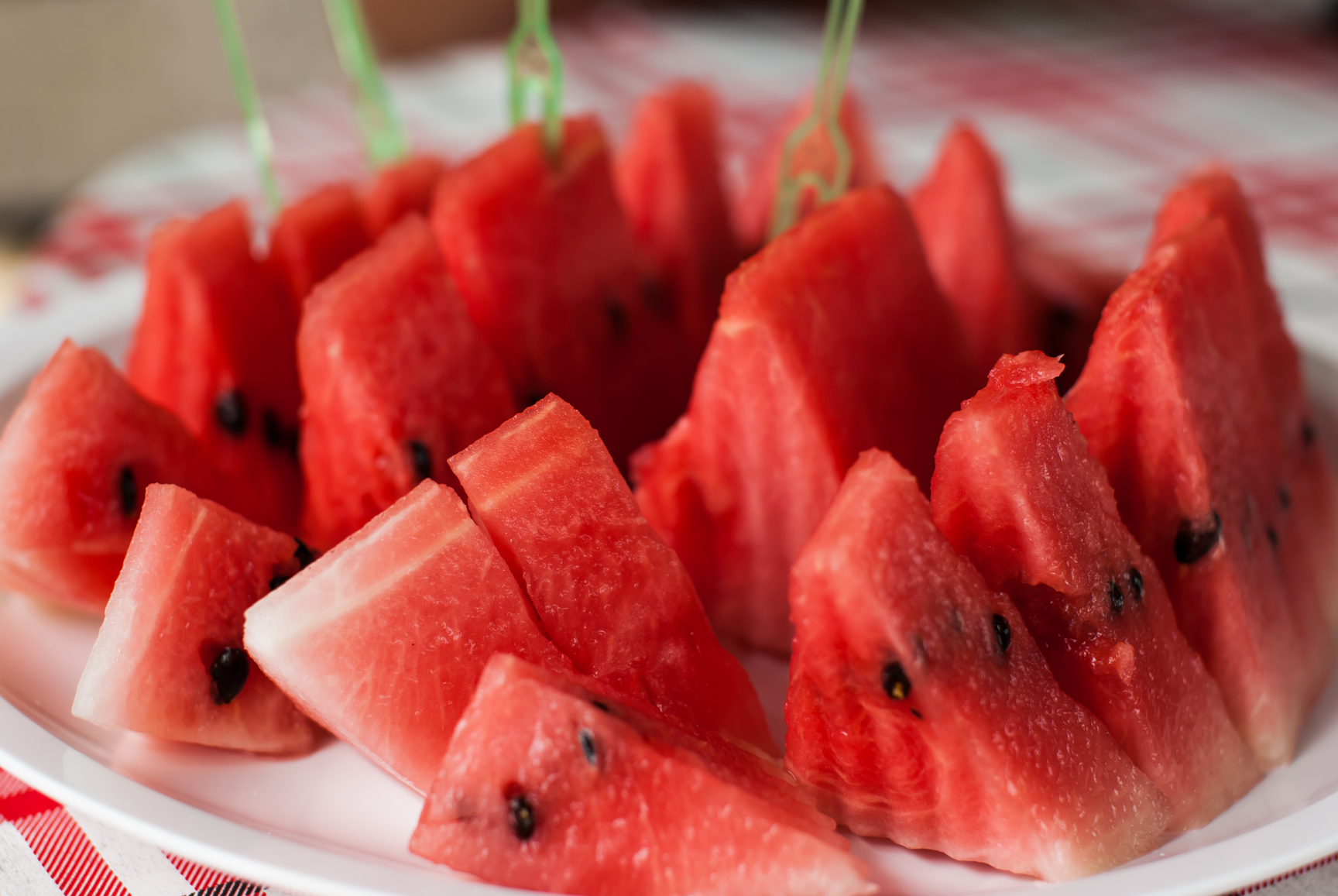
Watermelon Slices on dishI’ve been noticing whole and quartered watermelons at my local market.  It’s not time for local watermelon where I live, but now it’s pretty easy to watermelon year round – even in colder climates.

Watermelon seems to go hand in hand with warmer weather and certainly with the lazy, hazy days of summer. How much fun is it to sit on some porch steps or on a big rock and spit watermelon seeds — maybe even have a distance contest.  Okay – so not everyone gets as much of a kick out of it as I do, but it’s been fun since I was a kid.

Watermelon was – and still is – a treat.  Chunks and slices of watermelon have certainly finished off lots of camp meals and family picnics. Finishing off a meal with a platter of watermelon is common in Greece and other Mediterranean countries. How great is sweet, juicy watermelon on a hot day?  What about the college special: watermelon infused with vodka – or when money was scarce, grain alcohol?  And, how pretty are those intricate carved watermelon baskets filled with watermelon, cantaloupe, and honeydew balls?

A Melon With History

The first recorded watermelon harvest was in Egypt, nearly 5,000 years ago. Now you can find more than 1,200 varieties, which are are grown in 96 countries.  Watermelon, 92% water and 6% sugar, considered both a fruit and vegetable, is a cousin of cucumbers, pumpkins, and squash and is the most consumed melon in the US, followed by cantaloupe and honeydew.

Some Watermelon Facts

  • Because of its water content – it’s 92% water — watermelon is a volume food. It fills you up and quenches your thirst, and is great for weight control.
  • 1 wedge (about 1/16 of a melon, 286 g) has 86 calories, no fat, 22g carbs, 1g fiber, 2g protein.
  • 10 watermelon balls (122g) have 37 calories, 0 fat, 9g carbs, 0g fiber, 1g protein
  • 1 cup of diced watermelon (152g) has 46 calories, 0g fat, 11g carbs, 1g fiber, 1g protein
  • Two cups of watermelon chunks will supply 25% of your daily vitamin A, 30% of your daily vitamin C, B6 (6%) of B6; 8% potassium, 4% phosphorus, and 8% magnesium as well as beta carotene and lycopene (red flesh melons).
  • The inner rind is edible and has a bunch of hidden nutrients.  The outer rind, also edible, is sometimes used as a stir-fried or stewed vegetable or pickled condiment.
  • When you buy a watermelon look for one that is firm, symmetrical, and free from bruises, cuts, or dents. It should be heavy for its size and its underside should have a creamy yellow spot from where it sat on the ground while it ripened in the sun.
  • Whole melons will keep for 7 to 10 days at room temperature but lose flavor and texture if they’re stored too long. They’ll keep for three to four days in the fridge after they’re cut.

A Fantastic Sweet And Salty Combination

Here’s a recipe for a great watermelon, feta, and greens salad that is low in calories and fat. Sweet, salty, crunchy, yumm.

Mediterranean Watermelon Salad

Ingredients: (adapted from watermelon.org)

  • 6 cups torn mixed salad greens
  • 3 cups cubed seeded watermelon
  • 1/2 cup sliced red onion
  • 1/3 cup crumbled feta cheese
  • 1/2 cup watermelon vinaigrette
  • Freshly ground black pepper
  • Mint sprigs

Watermelon Vinaigrette:

  • 2 tablespoons honey
  • 1/4 cup pureed watermelon (puree chunks in a food processor)
  • 2 tablespoons white wine vinegar
  • 1/4 teaspoon pepper
  • 1 teaspoon olive oil

Directions:

To make the vinaigrette:  whisk together all ithe ngredients; store in refrigerator; shake well before using. Makes about 1/2 cup.

To make the salad:  in large bowl, mix all the salad ingredients except the vinaigrette, pepper, and mint. Just before serving, toss the salad mixture with the vinaigrette. Garnish with pepper and mint sprigs.

Makes 6 servings, about 75 calories per serving.

Filed Under: Calorie Tips, Healthy Eating, Food Facts, Eating with Family and Friends, Entertaining, Buffets, Parties, Events, Manage Your Weight, Snacking, Noshing, Tasting Tagged With: 30 ways to have low calorie fun in the sun, calories in watermelon, fruit, summer fruit, watermelon

How Many Calories Are In Your Favorite Alcoholic and Non-Alcoholic Summer Drinks?

May 29, 2014 By Penny Klatell, PhD, RN 1 Comment

Favorite-summer-drinkIt’s hot.  You’re thirsty.  You want something cool – or maybe ice cold – to drink.

Check Out The Calories

A lot of cool, refreshing drinks come with a hefty dose of calories. You might be surprised how many are in a drink you’ve been having for years.

According to CSPI (Center for Science in the Public Interest), carbonated soft drinks are the single biggest source of calories in the American diet.  It’s easy to forget about the calories in sugared sports drinks, sweetened ice teas, juices, and alcoholic beverages.

Alcohol isn’t a caloric bargain – it has 7 calories per gram (protein and carbs have 4 calories per gram and fat has 9 calories per gram). Add sweetened juices, syrups, or soda to your alcohol, and you could be drinking a significant portion of your suggested daily calorie allowance.

It helps to do some research to figure out what’s your best choice to grab from the deli, the food truck, the coffee shop, or at the bar.

Can you be satisfied with a bottle of beer that has around 100 calories rather than another brand that has around 300 – or water with a hint of flavor instead of a sports drink?

To help you with your choices, here are the calories in some summer favorites:

Water and Sports Drinks

  • Gatorade, 12 ounces:  80 calories
  • Gatorade G Orange, 12 ounce bottle:  80 calories
  • Gatorade G2 Perform Low Calorie Orange, 8 ounces: 20 calories
  • SoBe Lifewater, 20 ounces: 90 calories
  • Sobe Lifewater 0 calories Black & Blue Berry, 8 ounces: 0 calories
  • Glaceau Smart Water, 33.8 ounces: 0 calories
  • Vitamin Water, 20 ounces: 125 calories
  • Vitamin Water 10, 20 ounces: 25 calories
  • Perrier Citron Lemon Lime, 22 ounce bottle:  0 calories
  • Vitamin Water Focus Kiwi-Strawberry, 20 ounce bottle:  125 calories
  • Hint Blackberry, 16 ounce bottle:  0 calories
  • Powerade, Grape, 8 ounces: 50 calories
  • Propel Kiwi-Strawberry, 8 ounces: 10 calories
  • Water (as much as you want):  0 calories

Iced Coffee and Tea Drinks

  • Dunkin’ Donuts Vanilla Bean Coolatta, 16 ounces: 430 calories
  • Dunkin’ Donuts Sweet Tea, 16 ounces: 120 calories
  • Starbuck’s Coffee Frappuccino, 16 ounces (grande): 240 calories
  • Starbuck’s Coffee Frappuccino light, 16 ounces grande: 110 calories
  • Tazo Unsweetened Shaken Iced Passion Tea:  0 calories
  • Iced Brewed Coffee with classic syrup, 12 ounces (tall): 60 calories
  • Red Bull Energy Drink, 8.4 ounces, 110 calories

Soda and Non-Carbonated Drinks

  • Mountain Dew, 20 ounce bottle: 290 calories
  • Coke Classic, 20 ounce bottle: 233 calories
  • Diet coke, 20 ounce bottle: 0 calories
  • Snapple Orangeade, 16 ounces:  200 calories
  • San Pelligrino Limonata, 11.15 ounce can:  141 calories
  • Can of Coke, 12 ounces:  140 calories
  • Bottle of 7Up, 12 ounces:  150 calories
  • Root beer float, large, 32 ounces:  640 calories

Beer (12 ounce bottle)

  • Sierra Nevada Bigfoot Ale: 330 calories
  • Samuel Adams Boston Lager: 180 calories
  • Guinness Extra Stout: 176 calories
  • Pete’s Wicked Ale: 174 calories
  • Harpoon IPA: 170 calories
  • Heineken: 166 calories
  • Killian’s Irish Red: 163 calories
  • Long Trail: 163 calories
  • Molson Ice: 160 calories
  • Samuel Adams Brown Ale:  160 calories
  • Budweiser:  144 calories
  • Corona Light: 105 calories
  • Coors Light: 102 calories
  • Heineken Light: 99 calories
  • Budweiser Select: 99 calories
  • Miller Light: 96 calories
  • Amstel Light: 95 calories
  • Anheuser Busch Natural Light: 95 calories
  • Michelob Ultra: 95 calories
  • Miller MGD 64:  64 calories
  • Beck’s Premier Light: 64 calories

Wine

  • Red Wine, 5 ounces: 129 calories
  • White Wine, 5 ounces: 120 calories
  • Sangria, 8 ounces: 176 calories

Alcoholic Drinks

  • Mojito, 7 ounces: 172 calories
  • Frozen Magarita, 4 ounces: 180 calories (the average margarita glass holds 12 ounces, 540 calories)
  • Mimosa:  137 calories
  • Gin and Tonic:  175 calories

Fun In The Sun Cover


Want more information about low calorie fun in the sun?  Get my book from Amazon.

Filed Under: Calorie Tips, Healthy Eating, Food Facts, Eating with Family and Friends, Manage Your Weight, Snacking, Noshing, Tasting Tagged With: calories in alcoholic drinks, calories in beer, calories in drinks, calories in soda, calories in summer drinks, eat out eat well, low calorie fun in the sun

Three Tips To Avoid Overeating At A Barbecue

May 22, 2014 By Penny Klatell, PhD, RN Leave a Comment

barbecue Menu

It’s the start of the summer barbecue season and the accompanying temptation of a table loaded with delicious food. 

Here’s three easy tips to help avoid overeating:

1.  If you’re full, stop eating and clear your plate right away.  If a plate with food on it sticks around in front of you, you’ll keep picking at what’s on it until there’s nothing left. An exception – a study has found that looking at the “carnage” – the leftover bones from barbecued ribs or even the number of empty beer bottles – can serve as an “environmental cue” to stop eating.

2.  Do you really need to stand in front of the picnic table, kitchen table, or barbecue?  The further away from the food you are the less likely you are to eat it. Don’t sit or stand where you can see the food that’s calling your name. Keep your back to it if you can’t keep distant. There’s just so much control you can exercise before “see it = eat it.”  If staying near the food gets to be too much, go for a walk, a swim, or engage someone in an animated conversation. It’s pretty hard to shove food in your mouth when you’re busy talking.

3.  Before you grab some tasty ribs, dogs, burgers or pie — ask yourself if you really want it.  Are you hungry?  Is it worth the calories?  Odds are, the tempting display of food in front of you is visually seductive – and may smell great, too — but you’re reaching out to eat what’s in front of you for reasons not dictated by your stomach but by your eyes. Have you decided that you want to splurge on something specific? Try picking it ahead of time and commit to your choice so you don’t find yourself wavering in the face of temptation.

Filed Under: Calorie Tips, Healthy Eating, Food Facts, Eating with Family and Friends, Entertaining, Buffets, Parties, Events, Food for Fun and Thought, Manage Your Weight, Takeout, Prepared Food, Junk Food Tagged With: barbecue, barbecue food, overeating, tips for not overeating at a barbecue

Guess How Many Calories Are In Your Favorite Chocolate Bunnies and Eggs!

April 12, 2014 By Penny Klatell, PhD, RN Leave a Comment

chocolate bunnies and eggsEaster bunnies made of chocolate aren’t really that old a tradition, having been born in Germany in the 1800’s. Although other types of Easter candy like Peeps, jellybeans, and Cadbury eggs are extremely popular, the National Confectioners Association says that on Easter children head for chocolate Easter bunnies first. Adults probably do, too.

Chocolate Easter eggs are even younger than the chocolate bunnies.  John Cadbury made the first French eating chocolate in 1842, but the first Cadbury Easter eggs didn’t arrive until 1875 and were a far cry from today’s Cadbury Crème egg. Now there are tons of different types of chocolate eggs:  solid, hollow, and with all kinds of fillings.

Here are the average calories in popular types of chocolate Easter eggs:

Hershey’s

  • Cadbury Chocolate Crème Easter Egg, 1 egg (39g): 180 calories, 8g fat, 25g carbs
  • Cadbury Crème Egg, original milk chocolate with soft fondant crème center, 1 egg (39g): 170 calories, 6g fat), 28g carbs
  • Cadbury Mini Eggs, 1 package (1.4 ounces):  190 calories, 9g fat, 27g carbs
  • Cadbury Mini Caramel Eggs, 4 pieces (1.3 ounces):  180 calories, 9g fat, 23g carbs
  • Cadbury Mini Egg, 12 eggs (40g): 200 calories, 9g fat, 28g carbs
  • Milk Chocolate (foil) Eggs, 7 pieces (1.4 ounces): 200 calories, 12g fat, 24g carbs
  • Candy Coated Eggs, 8 pieces (1.3 ounces):  180 calories, 8g fat, 27g carbs

Dove

  • Silky Smooth Milk Chocolate Eggs, 6 eggs:  240 calories, 14g fat, 26g carbs
  • Foil Dark/Milk Chocolate Eggs, 6 eggs (1.5 ounces): 230 calories, 14g fat, 26g carbs

Reese’s

  • Milk Chocolate and Peanut Butter Eggs, 5 pieces (38g): 190 calories, 12g fat, 21g carbs
  • Reese’s Pastel Eggs, 12 pieces (1.4 ounces):  190 calories, 8g fat, 25g carbs
  • Reese’s Giant Peanut Butter Egg (whole egg, 6 ounces):  880 calories, 52g fat, 100g carbs

M&M’s

  • Milk Chocolate Speck-Tacular Eggs: 1/4 Cup (12 pieces): 210 calories, 10g fat, 29g carbs
  • M&M’s Peanut Butter Eggs, ¼ cup:  220 calories, 13g fat, 23g carbs
  • M&M’s Pretzel Eggs, ¼ cup:  180 calories, 6g fat, 28g carbs

Snickers

  • Original Peanut Butter Egg (1.1 ounce):  160 calories, 10g fat, 18g carbs
  • Snickers Mini Filled Egg (0.9 ounce): 130 calories, 6g fat, 17g carbs

Russell Stover

  • Caramel Egg (1 ounce):  130 calories, 6g fat, 19g carbs
  • Truffle Egg (1 ounce):  140 calories, 8g fat, 15g carbs

Whoppers

  • Robin Eggs, 8 pieces (1.4 ounces): 180 calories, 5g fat, 3g carbs
  • Mini Robin Eggs, 24 pieces (1.4 ounces):  190 calories, 5g fat, 35g carbs

Nestle

  • Butterfinger Eggs, 5 pieces (1.5 ounces):  210 calories, 11g fat, 29g carbs
  • Crunch Eggs, 5 pieces (1.3 ounces):  190 calories, 10g fat, 25g carbs

Here are the average calories in popular types of chocolate Easter bunnies:

  • Solid Milk Chocolate Easter Bunny (2.5 ounces): 370 calories (average)
  • Dove Solid Chocolate Easter Bunny, whole bunny (4.5 ounces):  675  calories
  • Cadbury Solid Milk Chocolate Easter Bunny:  890 calories
  • Lindt Dark/Milk Chocolate Bunny (1.4 ounces):  225 calories
  • Sees Whole Bunny (4.5 ounces):  650 calories
  • Reese’s Peanut Butter/Reester, whole bunny (5 ounces):  720 calories
  • Russell Stover, whole bunny (4 ounces):  630 calories

Easter Candy Facts and Fun

To learn enough about Easter Candy to wow everyone, grab a copy of the ebook, Easter Candy Facts and Fun, available from Amazon.

Filed Under: Calorie Tips, Healthy Eating, Food Facts, Eating with Family and Friends, Entertaining, Buffets, Parties, Events, Food for Fun and Thought, Holidays, Snacking, Noshing, Tasting Tagged With: calories in chocolate bunnies, calories in chocolate eggs, Easter, Easter basket, Easter candy, Easter Candy Facts and Fun

  • « Go to Previous Page
  • Go to page 1
  • Interim pages omitted …
  • Go to page 4
  • Go to page 5
  • Go to page 6
  • Go to page 7
  • Go to page 8
  • Interim pages omitted …
  • Go to page 27
  • Go to Next Page »

Primary Sidebar

Recent Posts

  • Buy Me Some Peanuts And Cracker Jacks
  • Is Your Coffee Or Tea Giving You A Pot Belly?
  • PEEPS: Do You Love Them or Hate Them?
  • JellyBeans!!!
  • Why Is Irish Soda Bread Called Soda Bread or Farl or Spotted Dog?

Topics

  • Calorie Tips, Healthy Eating, Food Facts
  • Eating on the Job
  • Eating with Family and Friends
  • Entertaining, Buffets, Parties, Events
  • Food for Fun and Thought
  • Holidays
  • Lose 5 Pounds in 5 Weeks
  • Manage Your Weight
  • Restaurants, Diners, Fast Food
  • Shopping, Cooking, Baking
  • Snacking, Noshing, Tasting
  • Takeout, Prepared Food, Junk Food
  • Travel, On Vacation, In the Car
  • Uncategorized

My posts may contain affiliate links. If you buy something through one of the links you won’t pay a penny more but I’ll receive a small commission, which will help me buy more products to test and then write about. I do not get compensated for reviews. Click here for more info.

The material on this site is not to be construed as professional health care advice and is intended to be used for informational purposes only.
Copyright © 2024 · Eat Out Eat Well®️. All Rights Reserved.